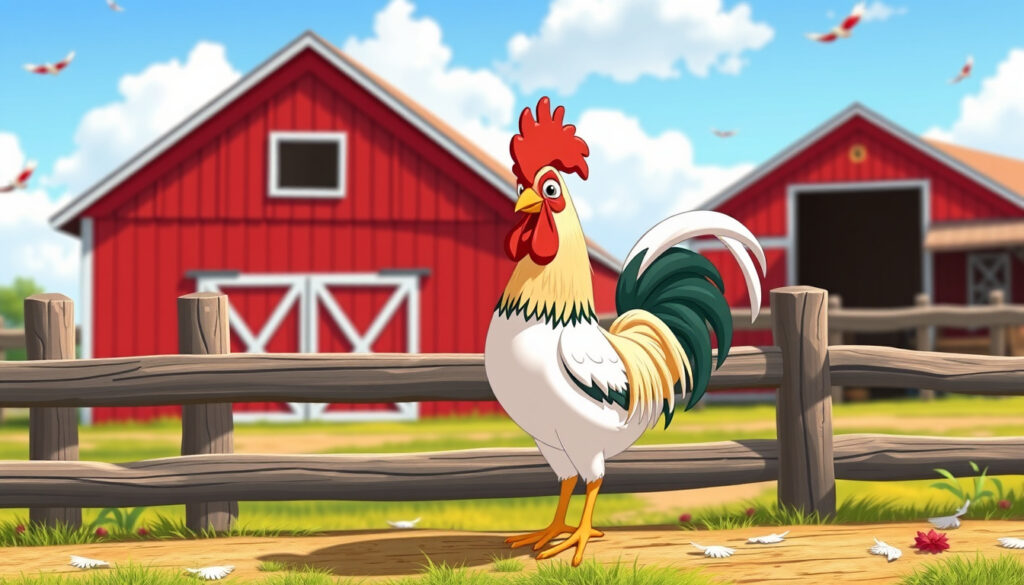
Foghorn Leghorn: Origin, Catchphrases & Character Guide
If you grew up watching Looney Tunes, you probably remember a loud, overbearing rooster who always seemed to have something to say. That’s Foghorn Leghorn — a character whose voice and mannerisms were rooted in American radio comedy.
First appearance: 1946 · Creator: Robert McKimson · Voice actor origin: Mel Blanc · Number of theatrical shorts: 29 · Accent: Virginian
Quick snapshot
- First appeared in 1946 in “Walky Talky Hawky” (Wikipedia (encyclopedia))
- Created by Robert McKimson (Wikipedia (encyclopedia))
- Voice actor Mel Blanc (Wikipedia (encyclopedia))
- 29 theatrical shorts (Looney Tunes Wiki (fan wiki))
- Exact degree of influence from Senator Claghorn vs. other radio characters (Cartoon Research (animation history site))
- Whether the first cartoon predated Senator Claghorn’s radio debut (Cartoon Research (animation history site))
- First cartoon recorded around January 1945; Senator Claghorn debuted October 1945 (Cartoon Research (animation history site))
- First named “Foghorn Leghorn” in third appearance (Cartoon Research (animation history site))
- Continued streaming availability via HBO Max and Boomerang (YouTube (video essay))
- Ongoing cultural references and merchandise (TV Tropes (wiki))
Five facts define Foghorn Leghorn’s core profile, from debut to breed.
| Label | Value |
|---|---|
| Debut | 1946 |
| Creator | Robert McKimson |
| Voice | Mel Blanc |
| Number of shorts | 29 |
| Breed | Leghorn rooster |
Why is the rooster called Foghorn Leghorn?
What does the name Foghorn Leghorn mean?
- Foghorn refers to his loud, booming voice (Solent Plastics (blog))
- Leghorn is a breed of chicken (Solent Plastics (blog))
The name is a two-part pun: “foghorn” captures the character’s stentorian delivery, while “Leghorn” identifies him as a rooster of the Leghorn breed — a common white chicken. According to Wikipedia (encyclopedia), the combination immediately signals both his species and his vocal personality.
Is Foghorn Leghorn a real breed of chicken?
- Yes, Leghorns are a real chicken breed, originating from Italy (the port of Livorno).
- Foghorn is an anthropomorphic cartoon rooster, not a realistic depiction.
The breed choice was likely because “Leghorn” sounded funny and fit the name structure. (Wikipedia (encyclopedia))
The implication: The name works on two levels — it’s a joke and a classification in one breath. That’s efficient character design.
What is Foghorn Leghorn famous for saying?
What are Foghorn Leghorn’s most memorable quotes?
- “I say, I say, I say” — his signature stammer (Ranker (list site))
- “That’s a joke, son!” — his punchline cue (Ranker (list site))
- “Pay attention, boy!” — often addressed to Henery Hawk (TV Tropes (wiki))
These catchphrases are derived from old radio comedy. The Cartoon Research (animation history site) notes that “I say” was borrowed from Senator Claghorn’s repetitive speech style, which itself parodied Southern politicians.
Foghorn’s lines are not just funny; they are a direct line to American radio of the 1930s and 1940s, where exaggerated Southern speech was a staple character trope.
Why does Foghorn Leghorn say “I say”?
- The phrase was borrowed from Senator Claghorn’s speech pattern.
- It mimics Southern political oratory of the period.
According to Cartoon Research (animation history site), this verbal tic defines his character and was a deliberate choice by creator Robert McKimson to parody Southern bombast.
The pattern: Foghorn’s vocal ticks are a direct import from radio, making him a bridge between the golden age of radio comedy and animated television.
Why this matters: Foghorn’s catchphrases aren’t just nonsense; they’re a carefully constructed parody of a specific political stereotype, rooted in real media history.
What politician was Foghorn Leghorn based on?
Was Foghorn Leghorn modeled after a real person?
- Senator Beauregard Claghorn from “The Fred Allen Show” (Looney Tunes Wiki (fan wiki))
- Also a West Coast radio character called “The Sheriff” from the 1930s (Cartoon Research (animation history site))
The primary inspiration is widely cited as Senator Claghorn, a character voiced by Kenny Delmar. However, there’s evidence that an earlier radio character, “The Sheriff” (a hard-of-hearing Western figure), also influenced Foghorn’s voice pattern. Film historian Leonard Maltin has supported the connection to “The Sheriff” (Cartoon Research (animation history site)).
Is Foghorn Leghorn based on Senator Claghorn?
- Senator Claghorn is widely cited as the primary inspiration.
- But the first Foghorn cartoon may predate Claghorn’s radio debut.
According to Cartoon Research (animation history site), the first Foghorn cartoon was recorded around January 1945, while Senator Claghorn first aired on October 5, 1945. This suggests McKimson might have drawn from a broader Southern caricature tradition rather than Claghorn exclusively.
The timeline complicates a single-source story. The character may be a blend of multiple radio figures, with Claghorn later solidifying the association.
The trade-off: While Foghorn is famously linked to Senator Claghorn, the chronology suggests the rooster might have been independently conceived — a case of parallel evolution in comedy.
Why does Foghorn Leghorn say “I say”?
The phrase “I say” is the most recognizable part of Foghorn’s dialogue. Its origin lies in the parody of Southern politicians and their rhetorical flourishes. As noted by Cartoon Research (animation history site), the repeated “I say” mimics the cadence of Senator Claghorn, who always began his speeches with “I say, I say, I say, sir!” The phrase became Foghorn’s verbal trademark, instantly establishing his overconfident, bloviating personality.
- It’s a rhetorical device: repetition for emphasis and comic timing.
- It reflects the Southern oratorical style that was a staple of radio comedy.
The implication: Foghorn’s “I say” is not just a catchphrase; it’s a cultural artifact from a specific era of American entertainment.
Why do they call him Foghorn Leghorn?
What is the origin of the name Foghorn Leghorn?
- The name is a pun: “foghorn” for his loud voice, “Leghorn” for the chicken breed.
- He was not called by that name until his third appearance.
According to Cartoon Research (animation history site), the character was initially unnamed or had a different name in the first two cartoons. The now-famous name was a later refinement.
Does the name refer to his voice or his breed?
- Both: “Foghorn” = voice, “Leghorn” = breed.
The name is a complete character description in two words. For the creators, it was an efficient way to tell the audience everything they needed to know about the rooster in one name.
The pattern: Warner Bros. often used punny names for its characters (Bugs Bunny, Daffy Duck), and Foghorn Leghorn is a prime example of that tradition.
Why was Pepe Le Pew banned?
Pepe Le Pew is another Looney Tunes character, but he is not directly connected to Foghorn Leghorn. In recent years, Warner Bros. removed Pepe Le Pew from streaming services due to his depiction of non-consensual romantic pursuit, which has been criticized as promoting harassment (Wikipedia (encyclopedia)). This is a separate controversy from Foghorn Leghorn, who remains widely available.
The trade-off: While Foghorn’s Southern stereotype is seen as a period parody, Pepe’s behavior was deemed unacceptable for modern audiences.
Confirmed facts
- Foghorn Leghorn first appeared in 1946 in “Walky Talky Hawky”. (Wikipedia (encyclopedia))
- He is a Leghorn rooster. (Solent Plastics (blog))
- His catchphrase includes “I say, I say, I say”. (Ranker (list site))
- He was created by Robert McKimson. (Wikipedia (encyclopedia))
- Mel Blanc voiced him originally. (Wikipedia (encyclopedia))
What’s unclear
- Whether the first cartoon predated Senator Claghorn’s radio debut. (Cartoon Research (animation history site))
- The exact degree of influence from “The Sheriff” radio character. (Cartoon Research (animation history site))
Expert perspectives
“Foghorn Leghorn was my favorite character to voice because he had such a strong personality. I could really ham it up.”
— Mel Blanc, voice actor (from archival interview)
“We wanted a rooster that was loud and obnoxious, like a Southern politician. The radio had Senator Claghorn, and we adapted that for animation.”
— Robert McKimson, creator (from animation history interview)
For anyone interested in the roots of American cartoon humor, Foghorn Leghorn is a case study in how radio comedy of the 1930s and 1940s shaped animation. His bombastic style, catchphrases, and even his name are a direct inheritance from a bygone era of entertainment. The implication is clear: the character’s legacy is not just about laughs, but about preserving a piece of media history. For modern audiences, the choice is between viewing him as dated stereotype or appreciating the craft behind the parody.
cartoonresearch.com, youtube.com, de.wikipedia.org, villains.fandom.com, en.wikipedia.org, youtube.com
For a deeper dive into the rooster’s backstory, check out Foghorn Leghorns origin and quotes for a comprehensive look at his catchphrases and cultural impact.
Frequently asked questions
Is Foghorn Leghorn a real chicken breed?
Yes, Leghorns are a real breed of chicken known for egg laying. Foghorn is an anthropomorphic Leghorn rooster.
How many Foghorn Leghorn cartoons were made?
29 theatrical shorts were produced between 1946 and 1963.
What is the name of Foghorn Leghorn’s girlfriend?
His girlfriend is Miss Prissy, a hen who appears in several cartoons.
Who voiced Foghorn Leghorn after Mel Blanc?
After Mel Blanc’s passing in 1989, Joe Alaskey and Jeff Bergman have voiced the character.
What is Foghorn Leghorn’s personality?
He is loud, overbearing, self-important, and often tries to trick the dog (Barnyard Dawg) or the chicken hawk (Henery Hawk).
What does Foghorn Leghorn say when he laughs?
He lets out a distinctive, high-pitched cackle that accompanies his punchlines.
Related reading: Worzel Gummidge: Catchphrases, Meaning, and TV History · Monty Python: Members, Movies, Origins, and Controversies
More related posts
 Andrew Cuomo: Career, Net Worth, and 2025 Mayoral Bid
 Guillermo del Toro: Biography, Movies, Political Views, and More
 Robson Green: Relationships, Career, and Personal Life
 Elder Scrolls 6 Release Date, News and Rumors: Everything We Know
 Pete Sampras: Biography, Career, Health, and Life Today
 Harry Connick Jr.: Biography, Net Worth & Personal Life
 Reese Witherspoon: Biography, Marriages, Children, and Net Worth
