Measurement Tape: How to Read and Use It (Inches & Centimeters)
Ever needed to measure something but couldn’t find the tape? You’re not alone — whether it’s checking a waist size before ordering clothes or figuring out if a new sofa will fit the living room, a measuring tape is one of those tools everyone reaches for. This guide walks you through reading a tape measure in inches and centimeters, explains how to use your iPhone as a backup, and shares practical tips from health and sewing experts so you can measure with confidence — even when the tape is nowhere in sight.
Standard tape measure lengths: 12 ft (3.6 m) to 100 ft (30 m) · Common blade widths: 1 inch (25 mm) or 3/4 inch (19 mm) · Smallest imperial division: 1/16 inch · Metric side divisions: 1 mm · iPhone Measure app accuracy: Within 1 cm at 1 m distance
Quick snapshot
- iPhone Measure app uses ARKit and is pre-installed on iOS 12+ (YouTube demo)
- Tape measures typically have both imperial and metric scales (wikiHow)
- The metal hook moves 1/16 inch for accurate inside/outside measurement (wikiHow)
- For body measurements, NHS trusts recommend a flexible tape on bare skin (East Lancashire Hospitals NHS Trust)
- Long-term durability of different tape measure brands lacks independent testing (Profile Glass)
- Exact accuracy of third‑party Android measurement apps varies by device and software version (Profile Glass)
- First tape measure patent: 1868 by Alvin J. Fellows
- iPhone Measure app launched with iOS 12 in 2018
- AR‑based apps are improving, but physical tape measures remain the gold standard for precision body measurements (Reddit user reports)
- Bluetooth‑enabled tape measures (e.g., Renpho) are gaining traction for fitness tracking (Reddit user reports)
Six key facts that define the measurement landscape today.
| Label | Value |
|---|---|
| First tape measure patent | 1868 by Alvin J. Fellows |
| Standard construction tape length | 25 ft (7.6 m) – most common in trade |
| iPhone Measure app release | iOS 12 (2018) |
| Body tape measure typical length | 60 inches (150 cm) – ideal for clothing sizing |
| Smallest imperial division | 1/16 inch (allows ± 1/32 inch resolution) |
| Smallest metric division | 1 mm (common on most dual‑scale tapes) |
Can I use my phone as a tape measure?
How does the iPhone Measure app work?
Apple’s Measure app, released with iOS 12, uses the camera and ARKit technology to estimate the distance between two points in the real world. The app is pre‑installed on most iPhones or available free from the App Store, and it can measure straight lines, rectangles, and even automatically detect the dimensions of a photo frame or poster (YouTube demonstration). For quick checks – like “does this bookshelf fit the alcove?” – the Measure app often delivers a usable answer.
What are the limitations of phone‑based measuring?
The biggest catch is accuracy. Apple’s own documentation states the Measure app is accurate within 1 cm at a distance of 1 m, but that error margin grows with distance and poor lighting. The app struggles with edges that lack contrast and can’t wrap around curves – a deal‑breaker for body measurements. A review from Blinds Direct (home improvement retailer) notes the app is simpler to use than some competitors but lacks advanced tools like a bubble level or continuous measurement. For precision work, a physical tape measure remains the better choice.
iPhone Measure is fine for rough furniture checks, but anyone needing waist or bust measurements should stick to a flexible tape – the phone simply can’t follow a curved path.
The implication: phone apps complement physical tapes, but they don’t replace them – especially when the measurement requires wrapping around a body or object.
How can you read a measuring tape?
Understanding inch markings: 1/16, 1/8, 1/4, 1/2
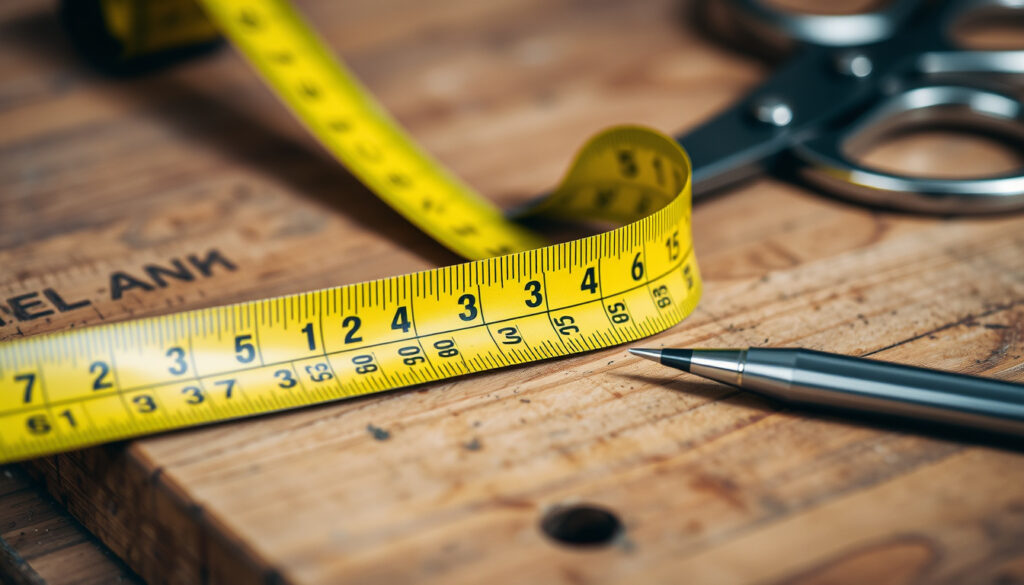
Most tapes sold in the US and UK have the imperial scale on the top edge. The largest marks are whole inches (usually numbered). Between each inch, the longest line is the 1/2‑inch mark, followed by 1/4‑inch marks, then 1/8‑inch, and the shortest lines are 1/16‑inch (wikiHow). For example, the line that is three ticks past the 3‑inch mark is 3 3/16 inches.
Reading metric side: millimeters and centimeters
On the bottom edge, the tape typically shows centimeters and millimeters. Each numbered mark is a centimeter, and the small unnumbered lines are millimeters. The first mm after the 5 cm mark gives you 5.1 cm (51 mm). This side is used for scientific or European‑standard measurements where decimal precision is required.
Common mistakes beginners make
- Starting from the hook’s end: remember the hook slides 1/16 inch to compensate for its own thickness – this is by design (wikiHow).
- Not pulling the tape taut – a slack tape adds error, especially over longer distances.
- Mixing up 1/8 and 1/16 marks: the 1/8 line is longer than the 1/16 line; practice counting the smallest ticks.
The pattern: once you memorise the hierarchy of line lengths, reading becomes intuitive – and the metric side is even simpler because it’s purely decimal.
Is a measuring tape in inches or centimeters?
Dual‑scale tape measures
Nearly all modern tape measures include both imperial and metric scales on opposite edges of the blade. The imperial side uses inches (divided into fractions), while the metric side uses centimeters and millimeters. This dual‑scale design lets one tool work for construction (US customary) and for scientific or European projects (wikiHow).
When to use inches vs centimeters
In the United States and UK, inches are the standard for construction, carpentry, and most household projects. Centimeters (and millimeters) are the norm in science, medicine, clothing patterns from European brands, and many international DIY contexts. The East Lancashire Hospitals NHS Trust uses centimeters for waist and hip measurement guidance, reflecting the medical standard.
Converting between units
1 inch = 2.54 centimeters exactly. To convert inches to cm, multiply the inches by 2.54. For quick mental maths: 4 inches ≈ 10 cm. Online converters and the iPhone’s Calculator app (in landscape mode) can handle conversions instantly.
What this means: if you’re following a European sewing pattern, read the metric side. If you’re measuring lumber for a US deck, use inches. The double scale lets you do both without a second tool.
What can I use if I don’t have a measuring tape?
Smartphone measurement apps
Besides Apple’s Measure, several AR apps offer more features. Profile Glass (UK glazing specialist) recommends Moasure (acts as a tape measure, ruler, protractor, and goniometer), PLNAR (creates 3D room models), and CamToPlan (measures walls, baseboards, and furniture from the screen). AirMeasure provides a flashlight mode for dark areas (Blinds Direct). Android users need a third‑party app – there’s no built‑in equivalent.
Using a ruler or yardstick
A rigid ruler or yardstick works for straight-line measurements under a few feet. For longer distances, you can mark increments on the floor with a piece of string or a belt, then measure the string with a ruler.
Improvised measuring with known objects
Your own body can serve as a rough guide: a standard credit card is 3.375 inches wide (85.6 mm), a US dollar bill is 6.14 inches long, and the distance from your elbow to fingertips is approximately your height in centimeters divided by 10. These tricks are handy when you’re away from your toolbox, but they aren’t substitutes for a real tape measure when accuracy matters.
The catch: improvised methods are fine for estimation, but anything requiring precise fit – like installing a shelf or ordering clothes – demands a proper measuring tool.
Three critical specs that separate a general‑purpose tape from a specialist body‑measuring tape.
| Specification | Typical construction tape (25 ft) | Body/fabric tape (60 in) | Blade material |
|---|---|---|---|
| Length | 25 ft (7.6 m) | 60 in (150 cm) | Steel or fiberglass |
| Blade width | 1 in (25 mm) | 0.5 in (13 mm) | Fiberglass or cloth |
| Smallest division (imperial) | 1/16 in | 1/8 in | – |
| Smallest division (metric) | 1 mm | 1 mm | – |
| Hook | Metal, sliding | Metal or plastic, fixed | – |
| Retraction | Automatic spring | Manual (no spring) | – |
How to use a measuring tape for beginners?
Holding the tape correctly
For a rigid tape, hook the metal tab over the edge of the object, keep the blade straight, and pull it taut until the mark aligns. For body measurements, hold the tape flat against the skin – the NHS guidance emphasises that the tape should be snug but not tight enough to indent the skin. Measurements are best taken on bare skin or over a single thin layer.
Reading the hook end
The metal hook on a standard tape measure is designed to slide by exactly its own thickness (typically 1/16 inch). When you push the hook against an inside edge (like a window frame), the hook slides in; when you hook it over an outside edge, the hook slides out. This auto‑compensation gives you an accurate reading either way – no need to subtract the hook’s width (wikiHow).
Measuring curved surfaces
A rigid carpenter’s tape won’t conform to curves – that’s where a flexible cloth or fiberglass tape comes in. For waist measurement, NHS guidelines advise placing the tape halfway between the bottom of the ribs and the top of the hips, then reading after a full exhale. Made by Rae (sewing pattern designer) notes that the natural waist is often well above the belly button, so don’t assume it matches where your pants sit. Measure twice for consistency.
A wrong body measurement can ruin a sewing project or lead to ill‑fitting clothes. Using a flexible tape and following NHS‑level guidance reduces the margin of error to nearly zero.
The trade‑off: construction tapes are built for durability on job sites, but their rigid blades can’t handle body curves. Pick the right tool for the task – and when in doubt, go with a fabric tape for any measurement that wraps.
Confirmed facts
- iPhone Measure app uses ARKit and is pre‑installed on iOS 12+ (YouTube)
- Tape measures include both imperial and metric scales (wikiHow)
- The metal hook compensates for its own thickness by sliding 1/16 in (wikiHow)
- NHS trust advises measuring waist halfway between ribs and hip after exhaling (East Lancashire Hospitals NHS Trust)
- Moasure app can measure distance, angle, and level using AR (Profile Glass)
What’s unclear
- Long-term reliability of budget tape measure brands is unverified
- Android phone measurement accuracy varies dramatically by device and app version (Profile Glass)
- Reported use of Renpho Bluetooth tape for body tracking (Reddit) – lacks independent validation
- YouTube tutorials for bust and hip measurement lack peer‑reviewed standards (YouTube)
For body measurements, the tape should be snug but not tight, and the measurement should be taken with the tape level and parallel to the ground.
— East Lancashire Hospitals NHS Trust (UK public health authority)
Apple’s Measure app can measure real‑world objects with an iPhone camera. The app is preinstalled on many iPhones or available free from the App Store.
— Apple Support documentation (via YouTube review)
Measuring twice improves accuracy for body measurements.
— East Lancashire Hospitals NHS Trust
For DIY enthusiasts measuring furniture – such as the IKEA BILLY bookcase – accurate dimensions matter. Check out our IKEA BILLY Bookcase: Dimensions, Hacks, and Accessories guide for precise fitting tips. And for a broader look at tape measure techniques and phone‑app alternatives, see How to Read a Measuring Tape: Accuracy and Phone Apps.
For anyone in the US or UK who regularly measures body dimensions – whether for sewing, fitness tracking, or health checks – the choice between a flexible tape and a phone app is clear: use a physical fabric tape for any measurement that requires wrapping around a curve, and keep the iPhone Measure app as a handy fallback for rough linear checks. The cost of guessing wrong on your waist size could be a wasted garment or an inaccurate health metric, so invest the few dollars in a proper body‑measuring tape and measure twice.
clarkconnect.com, youtube.com, youtube.com, tiktok.com, youtube.com
Frequently asked questions
How do I measure my waist with a tape measure?
Place the tape measure halfway between the bottom of your ribs and the top of your hip bone. Wrap it around your waist snugly – not tight enough to indent the skin – and read the measurement after exhaling fully. The tape should be level and parallel to the floor (East Lancashire Hospitals NHS Trust).
What is the difference between a tape measure and a ruler?
A tape measure is flexible and can measure curved surfaces and long distances (up to 100 ft). A ruler is rigid, typically 12–36 inches long, and best for short, straight measurements. For body measuring, only a flexible tape works.
Can I use a tape measure for sewing?
Yes – sewing uses a soft, flexible measuring tape (often 60 inches long) to take body measurements and to measure fabric. Cloth tapes are lightweight and easy to handle. Avoid using a metal carpenter’s tape for sewing because it won’t conform to curves.
How do I keep a tape measure from retracting?
Many tape measures have a locking button on the side or bottom. Slide it while pulling the tape out, then release to lock the blade in place. To retract, press the button again and let the tape slide back slowly to avoid injury.
What does the black diamond on a tape measure mean?
The black diamond – sometimes called a “truss mark” – appears every 19.2 inches. It’s used by carpenters to space roof trusses or studs in a five‑module layout (five trusses per 8 feet). Not all tape measures include this mark.
Are digital tape measures accurate?
Digital (laser) tape measures are accurate for straight-line distances up to about 50 feet, typically within ± 1/8 inch. They’re not suitable for body measurements because they can’t measure curves. They also require clear line‑of‑sight and reflective targets.
How do I measure a room without a tape measure?
Use a smartphone AR measuring app (like Apple Measure or Moasure on iOS, or CamToPlan on Android). Alternatively, walk heel‑to‑toe along the wall – an average foot is about 12 inches – or use a known object like a floor tile (often 12×12 inches) to count increments.
More related posts
 Billy Corgan: Facts on Ethnicity, Politics, Family & More
 Capricorn Horoscope Today – Love, Career, Health Predictions
 Hotels in Sydney: Best Areas, Costs & Insider Tips
 Melissa George: Biography, Children, Career, and Custody Battle
 Pete Sampras: Biography, Career, Health, and Life Today
 North East Link – Melbourne’s Major Infrastructure Project
 Aiper Pool Cleaner Review: Pros, Cons & Dolphin Comparison
 Sam Campbell Biography: Career, Awards, and Personal Life
