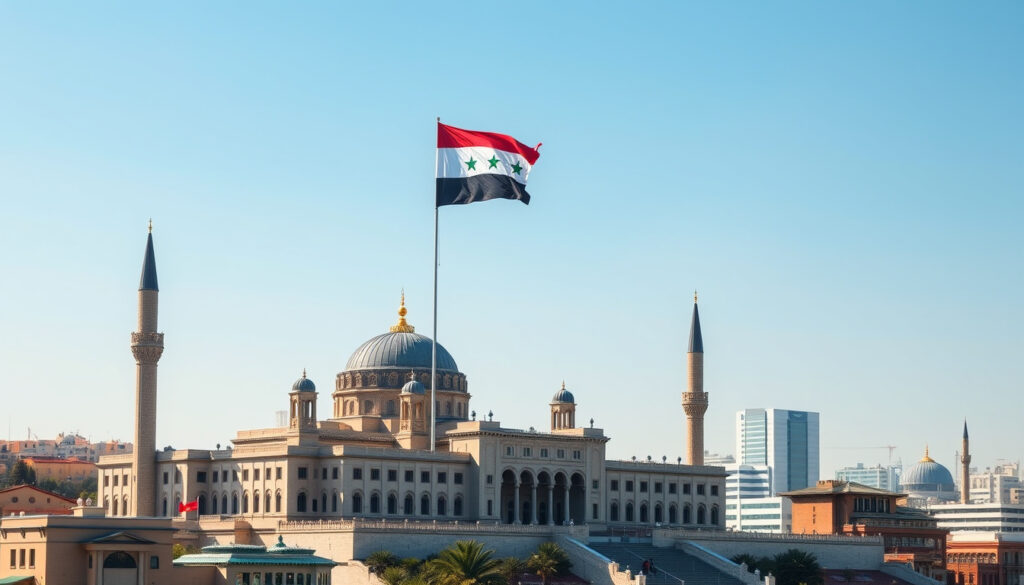
Ahmed al-Sharaa – Syria’s Interim President
Ahmed al-Sharaa, widely known by his nom de guerre Abu Mohammad al-Jolani, has emerged as one of the most consequential figures in modern Middle Eastern history. Born in 1982, this Syrian militant commander led Hayat Tahrir al-Sham (HTS) to a stunning military victory that toppled Bashar al-Assad’s regime in December 2024, fundamentally reshaping the political landscape of the region. His transformation from an al-Qaeda affiliate to the president of Syria’s interim government represents one of the most dramatic political reversals in recent memory.
Following the fall of Damascus, al-Sharaa assumed de facto control of Syria’s caretaker government before being formally appointed president at the Syrian Revolution Victory Conference in late January 2025. His journey spans decades of militant activity, strategic rebranding, and governance experiments in rebel-held territories. The international community watches closely as al-Sharaa attempts to transition from military commander to civilian leader while navigating complex relationships with regional powers, former adversaries, and Western governments that have designated HTS as a terrorist organization.
Who is Ahmed al-Sharaa?
Ahmed Hussein al-Sharaa, operating under the pseudonym Abu Mohammad al-Jolani, stands at the center of Syria’s political transformation. His real name remained relatively obscure for years as he built his reputation within militant circles, only becoming widely publicized in Western media following his ascent to power. Born on October 29, 1982, in Riyadh, Saudi Arabia, he spent much of his formative years in Damascus, where he developed the ideological foundations that would guide his subsequent militant activities.
Ahmed Hussein al-Sharaa
Abu Mohammad al-Jolani
HTS General Commander
President of Syria’s Interim Government
Al-Sharaa’s identity has been the subject of significant public interest as his profile has risen. His dual identity—maintaining his birth name within certain circles while widely recognized by his battlefield pseudonym—reflects the clandestine nature of his earlier operations. Western intelligence agencies have monitored his activities for over a decade, with his name appearing on various sanctions lists maintained by the United Nations and individual governments.
Key Facts About Ahmed al-Sharaa
- Founded al-Nusra Front in 2011 under direction from al-Qaeda leadership
- Separated from al-Qaeda in 2016, rebranding as Jabhat Fateh al-Sham
- Established the Syrian Salvation Government in Idlib as a technocratic administration
- Led HTS forces in the November-December 2024 offensive that captured Damascus
- Appointed president of Syria’s interim government on January 29, 2025
- Pledged inclusive governance and protection of minority communities
- Promised political transition culminating in elections within four years
Essential Biographical Data
| Fact | Details | Source |
|---|---|---|
| Birth Date | October 29, 1982 | Biographical records |
| Birth Place | Riyadh, Saudi Arabia | Biographical records |
| Early Residence | Damascus, Syria | Historical sources |
| U.S. Detention | 2006-2011, Camp Bucca, Iraq | Historical documentation |
| Al-Nusra Formation | 2011, under al-Qaeda direction | News reports, official statements |
| Al-Qaeda Split | 2016, rebranded as Jabhat Fateh al-Sham | Official HTS communications |
| HTS Formation | January 2017, merged factions under unified command | Official announcements |
| Damascus Capture | December 8, 2024 | News reports |
| Presidential Appointment | January 29, 2025 | Official Syrian sources |
What is Ahmed al-Sharaa’s Current Role in Syria?
Al-Sharaa now occupies the most powerful position in Syria, having transitioned from military commander to political leader following HTS’s decisive victory. His official title as president of the interim government carries significant weight, though the nature of his authority remains complex. From December 8, 2024, when HTS forces entered Damascus, until his formal appointment in late January 2025, al-Sharaa functioned as de facto ruler of the caretaker administration, making key decisions about governance while public institutions remained under the nominal oversight of interim Prime Minister Mohammad Ghazi al-Jalali.
Command Structure and Authority
As HTS General Commander, al-Sharaa maintained direct control over the armed faction that orchestrated Assad’s ouster. This military pedigree distinguishes his leadership from purely political predecessors, giving him credibility among various armed groups operating within Syria’s fragmented landscape. His authority extends beyond formal governmental structures, encompassing the loyalty of thousands of fighters who have fought under HTS banners since the organization’s formation.
Following his formal appointment, al-Sharaa dissolved the previous parliament, suspended the constitution, and established a new legislative council. This marks a significant shift from caretaker arrangements toward more formalized institutional structures, though the interim nature of these arrangements remains emphasized in official communications.
International Recognition Status
The international community’s response to al-Sharaa’s ascendancy has been cautious and measured. Several regional governments have engaged directly with his administration, recognizing the new political reality on the ground. However, Western nations, particularly the United States, maintain their designations of HTS as a terrorist organization, creating a complicated diplomatic dynamic as Syria seeks to reintegrate into the international system.
Diplomatic overtures have come from various directions. According to regional analysis, al-Sharaa has pursued restoration of ties with the United States, Russia, and key regional powers simultaneously, adopting a balancing approach designed to maximize legitimacy while minimizing risks of renewed international isolation.
Meetings with Regional and Minority Leaders
In the immediate aftermath of Aleppo’s capture, al-Sharaa demonstrated a diplomatic approach toward communities that had previously faced persecution under extremist rule. He met with Christian and Kurdish leaders in Aleppo, delivering a message that signaled a departure from sectarian policies of the past. His statement that “diversity is our strength, not a weakness” represented a notable rhetorical shift from the ideological positions of his earlier career, reflecting the political pragmatism that has characterized his transformation.
What Are Ahmed al-Sharaa’s Historical Ties?
Understanding al-Sharaa’s background requires examining his deep connections to the global jihadist movement, particularly his relationship with al-Qaeda. His journey from Iraq to Syria, his detention by American forces, and his subsequent role as an architect of armed rebellion have shaped both his military capabilities and political worldview. These historical ties remain central to debates about his character, intentions, and the reliability of his recent moderation.
Origins of Al-Qaeda Affiliation
Following the September 11 attacks, al-Sharaa joined jihadist efforts in Iraq, aligning himself with what would become the Islamic State of Iraq (ISI). His participation in this movement led to his capture by U.S. forces in 2006, resulting in five years of detention at Camp Bucca in southern Iraq. This American prison became infamous as a location where captured militants exchanged ideas and strategies, and analysts have noted how the detention facility effectively networked future insurgent leaders.
Upon his release in 2011, amid the chaos of Syria’s emerging uprising against Bashar al-Assad, al-Sharaa received directions from al-Qaeda’s central leadership. Abu Bakr al-Baghdadi, then leading ISI, tasked him with establishing a Syrian branch that would become al-Nusra Front. This mission represented a calculated expansion of al-Qaeda’s reach into the Syrian conflict, exploiting the revolutionary momentum while advancing the organization’s long-term strategic goals.
Hayat Tahrir al-Sham remains designated as a terrorist organization by the United States and several other governments. The U.S. State Department’s official list continues to include HTS, creating legal and diplomatic complications for international engagement with al-Sharaa’s government.
Al-Nusra Front Operations
By 2012, al-Nusra Front emerged as one of the most effective fighting forces against Assad’s government, gaining popularity through its military successes while concealing its ties to ISI. The organization prioritized local support over the transnational brutality favored by other jihadist groups, adopting a more pragmatic approach that resonated with ordinary Syrians exhausted by civil war. This early strategic flexibility foreshadowed al-Sharaa’s later political transformations.
During this period, al-Nusra’s leadership rejected negotiations with the Syrian government and pursued implementation of Sharia law without accommodations for minority communities. These positions reflected the ideological environment in which al-Sharaa operated, though his subsequent actions would demonstrate significant evolution from these foundational commitments.
Break with Al-Qaeda and ISIS
The relationship between al-Nusra and its parent organization deteriorated when al-Baghdadi attempted to absorb al-Nusra into ISIS in 2013. Al-Sharaa resisted this merger, sparking a brutal conflict between the two groups that would cost thousands of lives and weaken both organizations against their common enemies. This decision marked the first major strategic split in al-Sharaa’s career, demonstrating willingness to prioritize organizational autonomy over ideological loyalty.
In 2016, al-Sharaa formally severed al-Nusra’s remaining connections to al-Qaeda, rebranding the organization as Jabhat Fateh al-Sham in a move designed to enhance pragmatism and improve Western perceptions. This rebranding accompanied a broader shift toward governance-oriented activities, as the organization established administrative structures in Idlib province that would later form the foundation of its claim to legitimate rule.
Transformation of Public Image
Beginning around 2021, al-Sharaa undertook a deliberate campaign to rehabilitate his public image, appearing in media without the full face covering that had characterized his earlier years. This visual transformation coincided with statements emphasizing Syrian nationalism over transnational jihadism, minority protections over sectarian exclusivism, and governance competence over ideological purity.
According to comprehensive biographical analysis, these changes reflected both genuine strategic calculations and observed evolution in al-Sharaa’s worldview. HTS prioritized fighting against ISIS and remaining al-Qaeda elements, activities that generated some Western sympathy and demonstrated commitment to counterterrorism objectives that aligned with international interests.
What Has Ahmed al-Sharaa Said About Syria’s Future?
Al-Sharaa’s public statements since taking power have emphasized themes of stability, inclusivity, and national reconciliation. His December 8 speech at Damascus’s historic Umayyad Mosque marked the symbolic beginning of post-Assad Syria, with al-Sharaa characterizing the moment as “a new chapter in the history of the region.” His address condemned Iranian regional influence, sectarian division, and governmental corruption, framing the revolution as a rejection of foreign manipulation and authoritarian mismanagement.
Governance Vision and Transition Plans
The political transition framework unveiled by al-Sharaa includes several key commitments that define his vision for Syria’s future. His stated plans encompass a national conference designed to bring together diverse political actors, formation of an inclusive government that incorporates various ethnic and religious communities, and eventual elections within a timeframe of up to four years. These promises represent ambitious political engineering for a country devastated by over a decade of conflict.
Al-Sharaa has pledged to rebuild institutional capacity, integrate disparate armed factions into unified security structures, and restore relationships with the international community. The interim government under his leadership has emphasized continuity of essential services and normalized diplomatic engagement as immediate priorities.
Minority Protections and Inclusivity
Perhaps the most scrutinized aspect of al-Sharaa’s rhetoric involves his commitments to minority communities. His outreach to Christian and Kurdish populations in Aleppo represented concrete action accompanying his public statements, though skepticism remains regarding the durability of these assurances given his historical associations. The test of these commitments will come in daily governance decisions affecting religious minorities, political dissidents, and regional autonomy movements.
Interim Prime Minister al-Jalali has echoed this emphasis, expressing hope that Syria could become “a normal country” following years of exceptionalism driven by conflict and extremism. This framing suggests alignment between al-Sharaa and his civilian administrators on the goal of normalization, though significant obstacles remain in translating aspirational rhetoric into functional governance.
Diplomatic Positioning
Al-Sharaa’s approach to international relations involves careful balancing among competing powers. His administration has sought to restore ties with the United States, maintain Russia’s tolerance, and engage regional neighbors including Turkey and Arab states that previously supported opposition forces. This diplomatic diversification reflects lessons learned from other revolutionary movements that failed due to excessive dependence on single patrons.
The withdrawal of Hezbollah from Syria, driven by Israel’s military campaign, created strategic space that HTS exploited during its November 2024 offensive. Al-Sharaa has capitalized on this changed environment, positioning himself as a stabilizing force rather than the destabilizing revolutionary he represented previously.
Timeline of Ahmed al-Sharaa’s Rise
Tracing al-Sharaa’s trajectory reveals a gradual but decisive transformation from obscure militant to national leader. Each phase of his career built upon previous experiences, creating the foundation for his current position. The following chronology captures the essential milestones in this evolution.
- 1982: Born in Riyadh, Saudi Arabia; family relocates to Damascus
- 2006-2011: Detained by U.S. forces at Camp Bucca, Iraq
- 2011: Directed by al-Baghdadi to establish al-Nusra Front in Syria
- 2012: Al-Nusra emerges as major fighting force against Assad government
- 2013: Resists al-Baghdadi’s merger push, initiates conflict with ISIS
- 2016: Severs al-Qaeda ties, rebrands as Jabhat Fateh al-Sham
- 2017: Forms Hayat Tahrir al-Sham, establishes Syrian Salvation Government in Idlib
- 2021: Begins public image transformation, appears without face covering
- November 2024: Launches offensive capturing Aleppo
- December 8, 2024: HTS forces enter Damascus; Assad regime falls
- December 8, 2024 – January 29, 2025: Functions as de facto ruler of caretaker government
- January 29, 2025: Appointed president of interim government
What Remains Clear and Unclear About al-Sharaa
Assessing al-Sharaa’s leadership requires distinguishing between well-documented facts and areas where uncertainty persists. This distinction matters for understanding both his current position and the prospects for Syria’s political future under his guidance.
- HTS military control of Damascus
- Formal appointment as interim president
- Historical ties to al-Qaeda and ISI
- Five-year U.S. detention (2006-2011)
- Dissolution of parliament and constitution suspension
- Pledged transition timeline
- Durability of moderation commitment
- Actual extent of Western diplomatic recognition
- Family details and personal background
- Specific content of private assurances to minorities
- Long-term faction integration success
- Removal from international sanctions lists
The Broader Context of Syria’s Transformation
Al-Sharaa’s rise cannot be understood in isolation from the broader forces reshaping Syria and the wider Middle East. His success represents convergence of military capability, strategic patience, and favorable external circumstances that created opportunities unavailable to previous opposition movements. The interplay between local dynamics and regional competition provides essential context for evaluating his current position.
Israel’s military operations against Hezbollah significantly weakened the Iranian-backed network that had sustained Assad’s government throughout the civil war. Hezbollah’s withdrawal from Syrian territory removed a critical partner that had helped prop up the regime during its most difficult periods. Into this strategic vacuum stepped HTS, exploiting the moment with decisive military action that capitalized on years of preparation and organizational development.
The evolution of HTS from extremist faction to governance-capable organization reflects broader patterns in Middle Eastern history, where militant movements transform into political actors as circumstances change. Whether al-Sharaa can successfully navigate this transition while maintaining his own authority and satisfying diverse constituencies remains the central question surrounding Syria’s immediate future.
Statements and Sources
The available public record contains several direct statements attributed to al-Sharaa that illuminate his perspective and intentions. These quotes, drawn from various sources, provide insight into the messaging that has accompanied his rise to power.
“Diversity is our strength, not a weakness.”
— Statement to Christian and Kurdish leaders in Aleppo, November 2024
“A new chapter in the history of the region.”
— Speech at Umayyad Mosque, Damascus, December 8, 2024
These statements must be evaluated against the backdrop of their delivery circumstances and al-Sharaa’s documented history. Academic research, news organizations including BBC News, and institutional sources provide varying perspectives on the reliability of commitments made by leaders with al-Sharaa’s background.
Summary and Future Prospects
Ahmed al-Sharaa’s trajectory from al-Qaeda operative to president of Syria’s interim government represents one of the most remarkable political transformations in recent Middle Eastern history. His journey encompasses militant leadership, strategic rebranding, effective military campaigning, and now the profound challenge of governing a fractured nation. The international community watches with cautious interest as this former jihadist attempts to establish legitimacy while managing expectations from diverse domestic constituencies.
The coming months will test whether al-Sharaa’s moderate rhetoric translates into sustainable governance practices. His pledges of inclusive government, minority protections, and eventual elections must confront the practical difficulties of Syrian politics, where competing factions, regional interference, and economic collapse create obstacles that have defeated previous attempts at national reconciliation. For more analysis of political leadership dynamics in the region, see this chief leader profile examining leadership challenges in transitional contexts.
Frequently Asked Questions
More related posts
 Haley Lu Richardson: LGBTQ, Relationship, Movies, and Biography
 January Jones: Mad Men Star on Misophonia and Teen Son
 Benson Boone: Biography, Songs, and American Idol Journey
 Lee Sung-Kyung: Biography, Dating History, Height & Career Facts
 Stephen Silvagni: Career, Son’s Conviction, and Latest Updates
 Magento Service Companies by AelfTech: Verified vs Unverified
 Ocean Ramsey: Shark Conservationist, Model, and Controversy
 Liv Golf Adelaide 2026 – Dates, Venue, Tickets and Full Details
