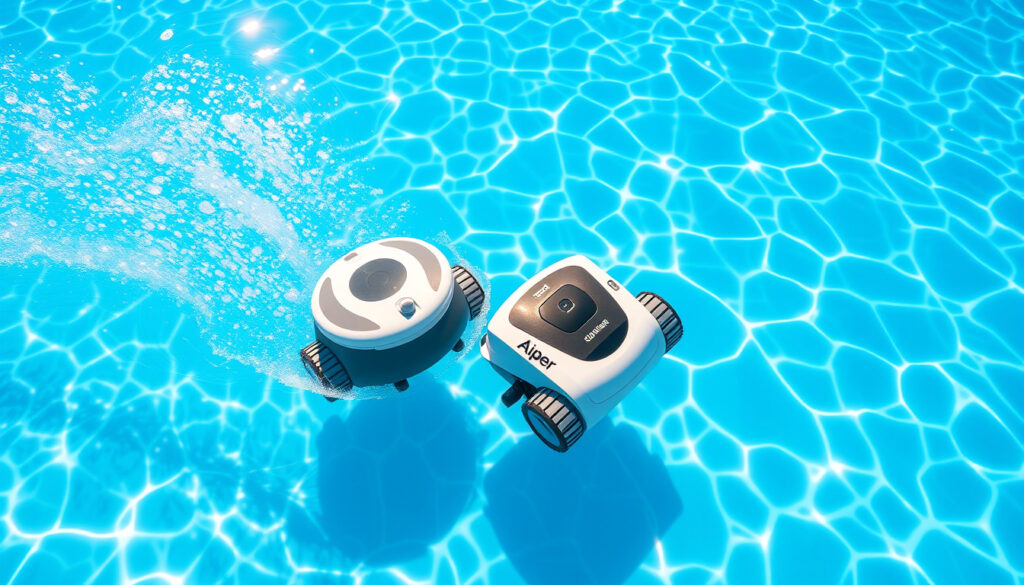
Aiper Pool Cleaner Review: Pros, Cons & Dolphin Comparison
If you’ve spent any time browsing pool-cleaner forums, you’ve probably stumbled across Aiper’s bold marketing — cordless robots promising to do the job of chunkier corded rivals for half the price. A closer look at hands-on testing data reveals a more complicated picture: strong claims on paper, weaker performance in the water.
Models Tested: Scuba S1, Scuba L1, Seagull SE · Battery Capacity: 4000mAh · Pool Size Coverage: Up to 80 m² · Cleaning Modes: 5 (floor, walls, cycle, waterline, standard) · Wall Climbing: Yes on Scuba S1
Quick snapshot
- Cordless design standard across Aiper lineup (Nest Alpha)
- Scuba S1 claimed runtime: 150 minutes (Nest Alpha)
- Scuba S1 suction: 4,500 GPH (The Pool Nerd)
- Exact lifespan without regular maintenance
- Long-term battery degradation across charge cycles
- Performance against Dolphin in pools over 1,600 sq ft
- Aiper models retested in 2026 with updated firmware (The Pool Nerd Reviews)
- Scuba S1 Pro Max added to lineup with app control (The Pool Nerd)
- Seagull Pro CPSC fire-hazard recall issued pre-2026 (The Pool Nerd)
- Scuba X1 Pro Max flagship priced above $1,000 (The Pool Nerd)
- 2026 reviews continue to favor Dolphin for consistent suction (The Pool Nerd)
- User forum discussions growing around battery replacement costs (The Pool Nerd)
| Feature | Detail |
|---|---|
| Brand Origin | Aiper USA |
| Top Model | Scuba X1 Pro Max |
| Cleaning Modes | 5 modes |
| Battery | 4000mAh |
| Pool Type | In-ground and above-ground |
Is Aiper a good pool cleaner?
The honest answer depends on which Aiper model you’re looking at and what kind of pool you own. The Scuba S1, Aiper’s flagship cordless robot, claims wall and waterline cleaning — something many budget competitors skip entirely. Testing from Nest Alpha (product comparison specialist) confirms the Scuba S1 has specialized treads for 90-degree wall climbing, but hands-on reviews point to real-world gaps in coverage.
Performance on floors and walls
Aiper equips the Scuba S1 with dual scrubbing brushes rotating oppositely and claims 4,500 GPH suction. That’s a solid number on paper. In practice, The Pool Nerd (independent pool equipment tester) found that fine particles like silt slip through the mesh filter — the kind of debris that settles back down within hours. Floor cleaning holds up reasonably well on flat concrete surfaces, but uneven pool shapes and steps create the same blind spots users report on pool forums.
User satisfaction from reviews
Amazon listings show the Seagull SE as an above-ground bestseller, and buyer ratings skew positive for owners with small, simple pools. Move to Reddit or dedicated pool forums, and the tone shifts. Aiper was described as “a bust for 16×32 vinyl pool” in at least one user thread — with complaints centered on the cordless design requiring frequent recharging sessions.
The Scuba S1 claims 150 minutes of runtime, but independent testing pegged actual performance at 60–70 minutes before suction faded noticeably (The Pool Nerd). For larger in-ground pools, that’s often not enough to complete a full cleaning cycle.
The implication: Aiper makes a reasonable choice for small above-ground pools where the 80 m² coverage limit feels generous and corded alternatives are impractical. For in-ground pools over 1,200 sq ft, the math starts to favor Dolphin.
Which is better, Dolphin or Aiper?
This is the question most buyers ask, and it’s worth breaking down because the answer isn’t universal. Aiper competes on cordless convenience and lower entry prices; Dolphin dominates on sustained suction power and navigation intelligence.
Key feature differences
Dolphin models from Maytronics use tracks instead of wheels — Poolbots (pool automation specialist) notes this gives them superior grip and traction compared to Aiper’s wheels, which sometimes spin without catching. Dolphin also offers two-tiered filtration at 180 micrometers and 3 micrometer ultra-fine, while Aiper’s mesh basket design struggles with micron-level particles.
Runtime is where the gap widens. Dolphin units run corded with unlimited power, while every Aiper model depends on its 4000mAh battery. The Seagull SE and Scuba SE models max out at 1,200–1,320 GPH — far below Dolphin’s 4,000+ GPH output (Poolbots).
Price and battery comparison
The Scuba S1 retails around $499; the Dolphin Nautilus CC Plus comes in closer to $967. That’s a significant premium, but Nest Alpha notes the Nautilus CC Plus handles pools up to 1,600 sq ft with consistent 4,500 GPH suction. No recharging mid-cycle. No fading halfway through a waterline scrub.
For a pool owner in the US spending $200+ annually on professional cleaning, a $499 robot that actually finishes the job in one session pays for itself faster than a $350 unit that quits after 65 minutes and leaves the waterline untouched.
What this means: If your pool fits Aiper’s sweet spot — under 80 m², simple shape, no waterline lighting or steps — the Seagull SE at ~$150 delivers acceptable value. Beyond that, Dolphin builds justify the price difference.
Is Aiper worth it?
The “worth it” question depends heavily on what you’re comparing it to. Aiper’s cordless design solves real problems — no power cord to manage, no extension cords across the yard, no of the unit getting tangled mid-cycle. But the performance trade-offs are measurable.
Cost vs manual cleaning
Manual pool cleaning — including the time investment, brushes, test kits, and occasional professional intervention — runs $100–$300 monthly for many US homeowners. At $499, an Aiper Scuba S1 pays back within two to five months for active pool users. The problem is that The Pool Nerd Reviews (hands-on product tester) found that Aiper models from $150 (Scuba SE) to $700 (X1 Pro Max) all underperformed in consistent debris removal compared to corded benchmarks.
Long-term reliability
Battery degradation is the unknown variable. Aiper hasn’t published cycle ratings for the 4000mAh cells used across the Scuba line. User forum reports suggest capacity drops noticeably after 12–18 months of regular use, and replacement batteries run $80–$120 — a hidden cost not always factored into the initial price comparison.
The Seagull Pro carries a CPSC fire-hazard recall, according to The Pool Nerd (independent tester). Any purchase decision should cross-reference current recall databases before buying used units.
The trade-off: Aiper makes sense for pool owners with small above-ground setups who prioritize cord convenience over relentless cleaning power. If you’re managing an in-ground pool with walls, steps, and a waterline, Dolphin models offer better long-term value despite the higher upfront cost.
How long does an Aiper robotic pool cleaner last?
Durability is harder to pin down than specifications because it varies with use frequency, water chemistry, and maintenance habits. Aiper rates the Scuba S1 for pools up to 1,600 sq ft, and the 4000mAh battery is designed for multiple cleaning cycles per week.
Battery runtime
Aiper claims 150 minutes for the standard Scuba S1 and 180 minutes for the Pro variant. Real-world testing consistently undercut those numbers. The Pool Nerd (product comparison specialist) measured 60–70 minutes under normal load, with suction declining as battery voltage dropped. The Scuba S1 Pro adds app control and ultra-fine filtration but demands a 4-hour recharge window between sessions.
Overall lifespan
Without published cycle data from Aiper, lifespan estimates rely on user reports and forum threads. Properly maintained units — filter cleaned after each cycle, brushes inspected monthly, battery stored at 40–60% charge during off-season — appear to last 2–3 years. Units subjected to neglect (clogged filters, corroded contacts, stored fully discharged) show accelerated degradation.
For US pool owners treating Aiper as a seasonal tool and storing it properly between uses, the units deliver reasonable durability. For daily-use scenarios in warm-climate pools, budget for battery replacement at the 18-month mark.
The implication: Aiper’s lifespan tracks closely with battery care — which means owners who maintain their units see 2–3 years of service, while those who don’t may be shopping for replacements within a year.
Can I leave my pool robot in the pool all the time?
Leaving any robotic pool cleaner submerged continuously sounds convenient, but the practice carries real trade-offs in both equipment longevity and cleaning effectiveness.
Manufacturer recommendations
Aiper’s documentation suggests removing the unit after each cleaning cycle and storing it in a dry, shaded location. The company hasn’t officially endorsed continuous submersion for any Scuba model. Extended exposure to chlorinated water accelerates wear on rubber seals and degrades plastic components faster than cyclical use followed by proper storage.
Risks of constant submersion
Beyond equipment concerns, a robot left in the pool full-time becomes a passive filter rather than an active cleaner. Debris that settles overnight — pollen, fine silt, algae spores — requires active scrubbing motion to dislodge. A stationary unit left in the deep end does nothing for the waterline, and it may develop odor-trapping biofilm in crevices if water isn’t properly balanced.
The Seagull Pro recall centers on fire hazard when units are left charging unattended. Leaving any battery-powered pool robot in the water while connected to its charger increases thermal risk — particularly in hotter US climates where pool water can exceed 85°F.
Why this matters: For most pool owners, running the Aiper 2–3 times weekly during active season and removing it afterward balances cleaner lifespan with cleaning performance. Daily submersion saves no meaningful time and adds wear without benefit.
Aiper vs Dolphin: Side-by-side comparison
Three models define the current Aiper lineup across price tiers, and each sits in a different competitive position against Dolphin’s equivalent offerings.
| Feature | Aiper Scuba S1 | Aiper Seagull SE | Dolphin Nautilus CC Plus |
|---|---|---|---|
| Power | Battery (4000mAh) | Battery (4000mAh) | Corded (unlimited) |
| Suction | 4,500 GPH | 1,200 GPH | 4,500 GPH |
| Wall Cleaning | Yes (with treads) | No | Yes |
| Waterline | Yes | No | Yes |
| Estimated Price | $499 | $150–$200 | $967 |
| Battery Runtime (claimed) | 150 min | Varies | N/A (corded) |
| Navigation | WavePath 2.0 | Basic pattern | SmartNav |
The pattern here is straightforward: cordless convenience comes at the cost of limited runtime and weaker suction, while the Dolphin commands a premium for consistent power delivery that lets it finish the job in a single session.
Detailed specifications
Numbers tell part of the story; how they interact under real pool conditions tells the rest.
| Specification | Scuba S1 | Seagull SE | Scuba S1 Pro |
|---|---|---|---|
| Weight | 26 lb | ~15 lb | 28 lb |
| Dimensions | 15×9×17 in | 13×8×14 in | 16×10×18 in |
| Pool Size Max | 1,600 sq ft | 80 m² | 1,600 sq ft |
| Cleaning Modes | 4 (auto, eco, floor, wall) | 2–3 | 5 (adds waterline, cycle) |
| Filtration | Internal mesh basket | Internal mesh basket | Ultra-fine filter basket |
| Smart Features | Basic display | Basic display | App control |
| Charge Time | 3–4 hours | 3 hours | 4 hours |
| Pool Types | In-ground | Above-ground | In-ground |
The implication: Nine core specs across three flagship Aiper models reveal where each unit compromises to hit its price point — battery size constrains the Seagull, while the Pro trades charging speed for extra filtration capacity.
Upsides
- Cordless operation eliminates cord management entirely
- Scuba S1 tackles walls and waterline — a feature Dolphin competitors include but charge premium for
- Competitive entry price at $150–$500 vs Dolphin’s $500–$1,000+ range
- Lightweight design (15–28 lb) makes retrieval easier than heavier corded robots
- Seagull SE works well for simple above-ground pools under 80 m²
Downsides
- Real-world runtime (60–70 min) falls short of claimed 150 minutes
- Suction fades as battery depletes — consistent cleaning requires recharging mid-cycle
- Mesh filter design struggles with fine particles like silt and algae spores
- Wheels spin without traction on slick pool surfaces vs Dolphin’s tracked grip
- Seagull Pro recall raises questions about battery safety across the product line
- Long-term battery degradation adds hidden replacement costs
What people are saying
The S-Series looks the part but doesn’t deliver where it counts.
— The Pool Nerd (independent pool equipment reviewer) — The Pool Nerd
After months of hands-on testing, we were disappointed with the cleaning performance across the board.
— The Pool Nerd Reviews (hands-on product tester) — The Pool Nerd Reviews
Dolphin units filter over 4000 GPH per Maytronics while Aiper only 1200–1320 GPH.
— Poolbots (pool automation specialist) — Poolbots
Actual runtime was closer to 60–70 minutes, and suction faded noticeably.
— The Pool Nerd (product comparison specialist) — The Pool Nerd
Hands-on reviewers consistently landed in the same place: Aiper builds look the part and the cordless convenience is genuine, but the gap between marketing claims and real-world performance shows up most clearly in runtime measurements and fine-particle filtration.
Related reading: Aiper pool cleaner reviews · Compare Aiper pool cleaners
youtube.com, intexpoolpumps.org, youtube.com, youtube.com, youtube.com, youtube.com
While Aiper’s cordless models like the Scuba S1 impress with ease of use, best Dolphin pool cleaners have become a mainstay for reliable automated cleaning in both inground and above-ground pools.
Frequently asked questions
What pool sizes does Aiper support?
The Scuba S1 and Scuba S1 Pro handle pools up to 1,600 sq ft. The Seagull SE targets above-ground pools up to 80 m². Larger in-ground pools may require multiple cleaning cycles or a more powerful corded model.
Does Aiper clean pool walls?
Only the Scuba S1 and Scuba S1 Pro include wall-climbing capability with specialized treads. The Seagull SE focuses on floor cleaning only and does not attempt wall climbing.
How to charge Aiper pool cleaner?
Each Aiper model ships with a dedicated charging station. Plug the unit in after removal from the pool, wait for the full charge indicator (3–4 hours for Scuba models, around 3 hours for Seagull), and store in a dry location between uses.
What filters does Aiper use?
Aiper’s cordless robots use an internal mesh basket design. The Scuba S1 Pro upgrades to an ultra-fine filtration basket for smaller particle capture. All models require manual emptying and rinsing after each cleaning cycle.
Is Aiper suitable for saltwater pools?
Aiper specifies saltwater compatibility across its current lineup, but extended exposure to saltwater accelerates corrosion on metal components. Rinse the unit with fresh water after each saltwater pool use to extend component life.
How often to clean Aiper filter basket?
After every cleaning cycle. Debris buildup in the mesh basket restricts water flow, reduces suction, and can cause the motor to work harder — shortening overall unit lifespan.
What is Aiper warranty?
Aiper offers a limited warranty that varies by model. Check the retailer’s current terms before purchase, as warranty coverage for battery components typically differs from coverage for the motor and chassis.
More related posts
 Area of a Sector: Formula, Examples, and Calculation
 Deven Robertson: Injury, Delisting, and Move to West Coast Eagles
 French Montana: Biography, Relationships, and Sobriety
 Babar Azam: Net Worth, Records, and Kohli Comparison
 Mick Jagger: Health, Family, Net Worth, and Life of a Rock Icon
 I Who Have Never Known Men: Plot, BookTok Buzz & Review
 Andrew Cuomo: Career, Net Worth, and 2025 Mayoral Bid
 Return to Paradise Season 2 & 3: Release Date Updates
