Gen Alpha Years – Birth Range, Traits and Key Facts
Generation Alpha represents the cohort born entirely within the 21st century, positioned as the successor to Generation Z and the first to experience artificial intelligence as a native technology. While most demographic researchers converge on a birth window beginning around 2010, significant disagreement persists regarding the exact endpoint, with proposals ranging from 2024 to 2029 depending on the source.
Australian social researcher Mark McCrindle, who coined the terminology in 2008, initially defined this cohort as spanning 2010 through 2024, establishing a standardized 15-year generational framework. However, competing definitions from Britannica, psychologist Jean Twenge, and other institutions introduce variations that shift these boundaries by several years, creating ambiguity for educators, marketers, and policymakers seeking precise demographic classification.
What Years Define Generation Alpha?
The most widely circulated definition positions Generation Alpha between 2010 and 2024, though this range exhibits considerable flexibility across demographic studies. Understanding these parameters requires examining the specific criteria researchers employ when distinguishing this cohort from preceding and succeeding generations.
| Attribute | Details | Source Authority |
|---|---|---|
| Start Year | 2010 (McCrindle) to 2013 (Twenge) | McCrindle Research |
| End Year | 2024 (McCrindle) to 2025 (Britannica) | Various |
| Current Age Range | 1–16 years (as of April 2026) | Calculated |
| Estimated Size | Nearly 2 billion globally | McCrindle/UN projections |
Key Characteristics of the Birth Window
- First generation born entirely within the 21st century and third millennium
- Entered a world where smartphones and tablets were already ubiquitous household items
- Represents the largest generational cohort in documented human history
- Boundaries lack a definitive historical “cutoff” event unlike prior generations defined by wars or economic shifts
- Demarcation depends heavily on technological adoption rather than geopolitical milestones
- Marketing and educational sectors increasingly prioritize this cohort’s emerging preferences
- Sibling relationships predominantly involve Generation Z older siblings
Definitive Data Points
| Fact | Value | Attribution |
|---|---|---|
| Term coined by | Mark McCrindle | 2008 |
| Common start year | 2010 | McCrindle Research |
| Alternative start proposal | 2013 | Jean Twenge |
| Common end year | 2024–2025 | Britannica, McCrindle |
| Preceding generation | Generation Z (1995–2009) | McCrindle |
| Following generation | Generation Beta (2025–2039) | McCrindle |
| Global population projection | ~2 billion by 2025 | McCrindle |
| Weekly births | 2.8 million | McCrindle |
| Digital milestone alignment | iPad and Instagram launch | 2010 |
| Generational span standard | 15 years | McCrindle |
Gen Alpha vs. Gen Z: Key Year Differences
The boundary between Generation Z and Generation Alpha remains the most contentious aspect of current demographic classification. Unlike the clear historical divisions that separated Baby Boomers from Generation X, the transition between these digital-native cohorts relies on subtle technological and cultural shifts rather than singular defining events.
Where Does Generation Z End?
Wikipedia’s entry on Generation Alpha documents the ongoing debate regarding Generation Z’s conclusion. McCrindle Research firmly places Generation Z between 1995 and 2009, making 2010 the definitive starting point for Generation Alpha. Conversely, other researchers extend Generation Z’s boundaries to 2012 or 2013, particularly when emphasizing shifts in social media platform adoption or mobile technology saturation.
The lack of consensus stems from varying definitions of when Generation Z concludes. While McCrindle Research established 2009 as Gen Z’s endpoint, other demographers extend Gen Z to 2012 or 2013, automatically delaying Gen Alpha’s commencement accordingly.
What Generation Comes After Gen Z?
Generation Alpha follows Generation Z in the demographic sequence, succeeded by Generation Beta (2025–2039) according to McCrindle’s projections. Children born in 2010 occupy the overlapping space where some classifications place them as late Generation Z while others identify them as early Generation Alpha pioneers.
Who Coined Gen Alpha and What Are Its Traits?
The terminology and conceptual framework for Generation Alpha emerged from specific research institutions rather than organic cultural adoption, distinguishing its naming history from predecessors like Millennials or Baby Boomers.
The Origin of the Term
Mark McCrindle, founder of the Australian consulting agency McCrindle Research, coined the term “Generation Alpha” in a 2008 report. The designation employs Alpha, the first letter of the Greek alphabet, representing both the exhaustion of the Latin alphabet sequence (X, Y, Z) and the commencement of an entirely new naming cycle. Springtide Research notes that McCrindle selected this approach because “going back to the beginning didn’t feel right for this next generation.”
Further details regarding the nomenclature appear in the report Understanding Generation Alpha, which contextualizes the naming within broader demographic research methodologies.
Digital Native Characteristics
Generation Alpha began entering the world in 2010, the same year Apple launched the iPad and Instagram debuted, creating an unprecedented alignment between birth years and transformative consumer technology. McCrindle’s generational infographic describes these individuals as “logged on and linked up,” representing “the most materially endowed and technologically literate generation to ever grace the planet.”
Family Structure Dynamics
Demographic research consistently identifies Millennials as the primary parental generation for Generation Alpha, with these children frequently serving as younger siblings to Generation Z members. This family configuration creates households where digital nativity spans multiple generational tiers, though Alpha represents the first cohort to encounter tablets and streaming services as standard environmental features rather than adopted innovations.
How Large Is the Gen Alpha Generation?
Quantifying Generation Alpha’s scale reveals unprecedented demographic weight, with implications for future labor markets, consumer economies, and urban planning requirements.
Global Population Statistics
When the final Generation Alpha members complete their birth years by 2025, the cohort will encompass nearly 2 billion individuals globally, establishing it as the largest generation in human history. Current birth rates sustain approximately 2.8 million new Generation Alpha members weekly worldwide. Many individuals within this cohort will live to see the 22nd century, given projected life expectancy trends.
Current Age Demographics
As of April 2026, Generation Alpha members range from approximately 1 to 16 years old. The oldest members, born in 2010, currently navigate mid-adolescence and early high school experiences, while the youngest remain in early childhood developmental stages.
With nearly 2 billion members projected by 2025, Generation Alpha already outnumbers Baby Boomers and Generation X combined, establishing unprecedented market influence despite their youth.
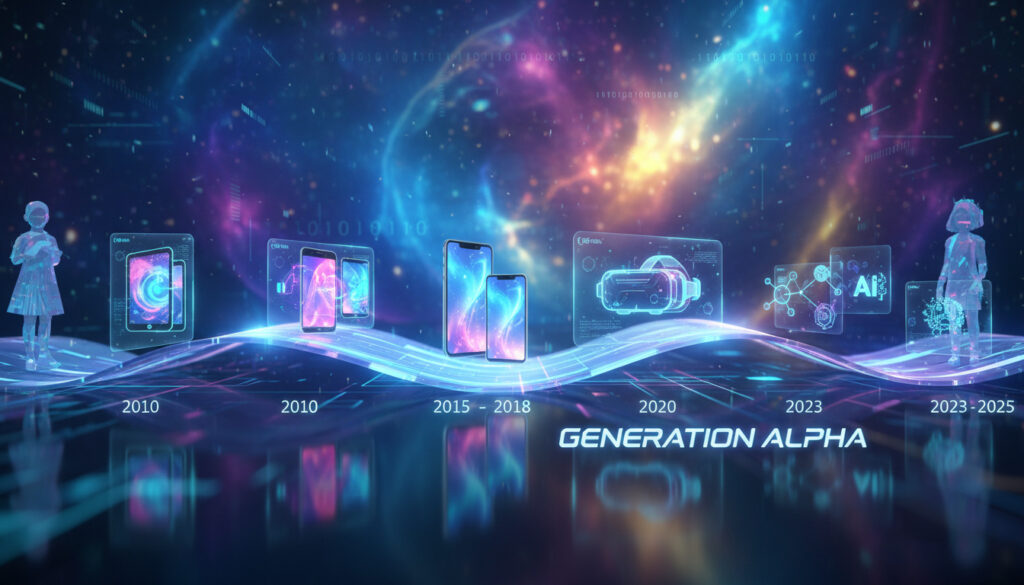
The Generation Alpha Timeline
- 2008: Mark McCrindle coins “Generation Alpha” in research report, establishing the conceptual framework
- 2010: iPad launches; Instagram founded; McCrindle designates as common Gen Alpha start year
- 2013: Alternative start date proposed by psychologist Jean Twenge and other researchers
- 2020: COVID-19 pandemic shapes early childhood development for mid-cohort members
- 2024: McCrindle’s projected end year for Generation Alpha births
- 2025: Britannica’s projected end year; Generation Beta commences per McCrindle’s model
Where Researchers Agree and Disagree
| Established Facts | Points of Debate |
|---|---|
| Coined by Mark McCrindle in 2008 | Exact start year: 2010 vs. 2013 |
| Follows Generation Z sequentially | End year: 2024 vs. 2025 vs. 2029 |
| First 21st-century-only generation | Global uniformity of definition |
| ~15-year generational span standard | Cultural vs. technological cutoff criteria |
| Digital native characteristics | Impact of COVID-19 as generational divider |
Why Generation Alpha Boundaries Matter
Precise demographic classification extends beyond academic categorization, directly influencing educational curriculum design, pediatric healthcare resource allocation, and long-term urban infrastructure planning. Unlike the Baby Boomer generation, defined by post-World War II birth rate spikes, or Generation X, shaped by Cold War contexts, Generation Alpha lacks a singular geopolitical marker, forcing researchers to rely on technological adoption curves and arbitrary calendar divisions.
This definitional fluidity creates practical challenges for marketing professionals targeting “tween” demographics and educators developing digital literacy programs. The absence of consensus regarding 2010 versus 2013 start dates, or 2024 versus 2025 endpoints, means that individuals born in transition years may receive differing generational labels depending on which research framework an organization adopts.
Expert Perspectives on Generation Alpha
Generation Alpha begins in the mid-2010s, representing the most materially endowed and technologically literate generation to ever grace the planet.
— Mark McCrindle, McCrindle Research
Going back to the beginning didn’t feel right for this next generation.
— Mark McCrindle, on selecting “Alpha” to follow Gen Z
Understanding Gen Alpha Years
Generation Alpha encompasses those born between approximately 2010 and 2024, though definitions vary by source, making it the first cohort born entirely within the 21st century and the largest generation in history at nearly 2 billion people. For the definitive framework established by the researcher who coined the term, consult Generation Alpha Defined.
Frequently Asked Questions
What generation is someone born in 2012?
Birth year 2012 falls within the transition period. McCrindle classifies 2012 as Gen Alpha, while definitions extending Gen Z to 2012 or 2013 would place these individuals at the tail end of Generation Z. The precise classification depends on which demographer’s timeline you reference.
Is 2025 still Gen Alpha?
According to McCrindle Research, 2025 marks the beginning of Generation Beta. However, Britannica and other sources define Generation Alpha as continuing through 2025. The year serves as a boundary point where definitions diverge between generational models.
Gen Alpha kids age now?
As of April 2026, Generation Alpha members range from approximately 1 to 16 years old. The oldest members born in 2010 are currently in their mid-teens, while the youngest are toddlers born in 2024.
What generation is 2010?
Most researchers, including Mark McCrindle, classify 2010 as the starting birth year for Generation Alpha. This year coincides with the launch of the iPad and Instagram, marking the beginning of the fully digital native generation.
When does Gen Alpha end?
Proposed end years vary by source. McCrindle Research designates 2024 as the endpoint, while Britannica extends the generation through 2025. Psychologist Jean Twenge suggests a later conclusion around 2029, indicating ongoing scholarly debate.
Why is there no consensus on Gen Alpha years?
Unlike previous generations defined by major geopolitical events, Gen Alpha boundaries rely on technological adoption curves and arbitrary 15-year cycles. Researchers disagree on when Generation Z concludes, directly affecting when Generation Alpha begins.
How many Gen Alpha births occur weekly?
Approximately 2.8 million Generation Alpha members are born globally each week, according to McCrindle Research. This birth rate contributes to the cohort’s projected status as the largest generation in history at roughly 2 billion people.
More related posts
 Gold Coast Suns – History, Players and 2025 Breakthrough
 Butter Chicken Sauce: Ingredients, Recipe, and Common Mistakes
 Josh Hutcherson: Height, Girlfriend, and LGBTQ Speculation Explained
 Marta Kostyuk: Biography, Ranking, and Sabalenka Tension
 CPI Increase 2024 – Official Data and Trends
 Tom Ford Tobacco Vanille: Scent, Performance & Compliments
 Lee Sung-Kyung: Biography, Dating History, Height & Career Facts
 Song Joong-ki: Wife, Children, Net Worth & Full Biography (2025)
