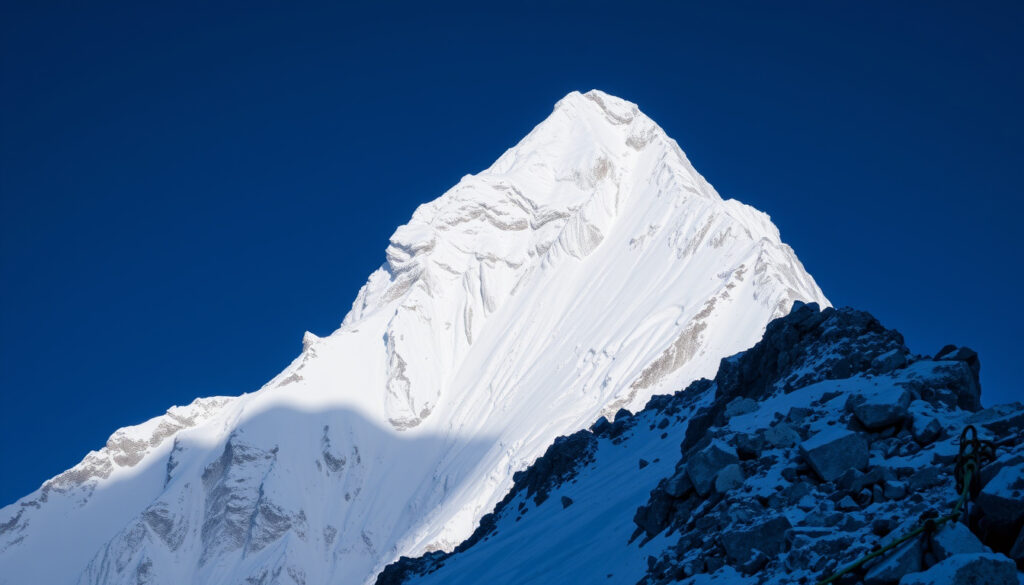
Mount Everest Peak: Height, Climbing Difficulty & Deaths
Few places on Earth command the mix of awe and caution that Mount Everest’s peak does. It’s the ultimate altitude — the highest point on the planet at 8,848.86 meters (CNN, international news outlet) — and the goal of hundreds of climbers each spring. But the reality behind the summit — the deaths, the myths, the sheer difficulty — is often distorted. This article separates fact from fiction, covering everything from the climbing experience to why commercial jets avoid flying over the peak.
Height: 8,848.86 meters (29,031.7 feet) ·
Location: Nepal / China (Tibet) border ·
First ascent: May 29, 1953 by Edmund Hillary and Tenzing Norgay ·
Total deaths (as of 2024): Approximately 340 ·
Average climbing season: April to May (pre-monsoon)
Quick snapshot
- 8,848.86 m (29,031.7 ft) (CNN, international news outlet)
- Nepal/Tibet border (CNN, international news outlet)
- Coordinates: 27°59′N 86°55′E (CNN, international news outlet)
- Edmund Hillary & Tenzing Norgay (Wikipedia, user-edited encyclopedia)
- May 29, 1953 (Wikipedia, user-edited encyclopedia)
- South Col route (Wikipedia, user-edited encyclopedia)
- April–May (pre-monsoon) (Wikipedia, user-edited encyclopedia)
- September–October (post-monsoon) but less common (Wikipedia, user-edited encyclopedia)
- Summit window: few days each spring (Wikipedia, user-edited encyclopedia)
- ~340 deaths total (Wikipedia, user-edited encyclopedia)
- Average 5 per year (Wikipedia, user-edited encyclopedia)
- Most deaths in death zone (Wikipedia, user-edited encyclopedia)
The key facts about Everest, summarized in a compact table.
| Attribute | Value |
|---|---|
| Height | 8,848.86 meters (29,031.7 feet) (Wikipedia, user-edited encyclopedia) |
| Location | Mahalangur Himal, Nepal/Tibet (Wikipedia, user-edited encyclopedia) |
| First ascent | 1953 by Hillary and Tenzing (Wikipedia, user-edited encyclopedia) |
| Number of attempts per year | ~800 permits issued (record 492 in 2026) (The Straits Times, Singapore newspaper) |
| Climbing duration | 2–3 months expedition |
What is the peak of Mount Everest?
Everest’s peak is the highest point on Earth, rising 8,848.86 meters above sea level. That figure was jointly confirmed by Nepal and China in 2020, ending decades of debate over whether the pre-1955 measurement of 8,848 meters or the earlier Indian survey of 8,847.73 meters was correct (CNN, international news outlet). The peak sits on the border of Nepal and Tibet, giving it two official names: Sagarmatha in Nepali and Qomolangma in Tibetan.
How was the height of Everest measured?
- The 2020 survey used GPS, ground-penetrating radar, and gravity measurements (CNN, international news outlet).
- Nepal and China each conducted their own surveys and then reconciled the figure.
- The new height is 0.86 meters higher than the previous official 8,848 meters.
Who named the peak?
- British surveyors named it after Sir George Everest in 1856.
- Locally it’s called Sagarmatha (Nepali) and Qomolangma (Tibetan).
- The Chinese government uses Qomolangma Feng.
The implication: The official height now reflects modern measurement technology, but the geographic and cultural identity of the peak has always been shared between two nations.
How many climbers died on Everest?
As of May 2024, approximately 340 people have died on Everest since the first attempts in the 1920s (Wikipedia, user-edited encyclopedia). The death toll fluctuates year to year; the average is about five per climbing season. Most fatalities occur in the “death zone” above 8,000 meters, where the body’s cells begin to die from oxygen deprivation.
How many climbers died on Everest per year?
- Annual deaths vary: 2014 had 16 (avalanche), 2015 had 14 (earthquake), 2019 had 11 (crowding).
- In 2023, Nepal issued a record 454 permits (Al Jazeera, international news organization), and the death count was 18.
- Crowding at the summit has been cited as a contributing factor in recent deaths (South China Morning Post, Hong Kong-based newspaper).
What famous person died on Everest?
- George Mallory (1924) – his body was found in 1999, but it’s unknown whether he reached the summit.
- Scott Fischer and Rob Hall (1996) – commercial guides killed in the infamous storm later chronicled in Into Thin Air.
- More recently, Hungarian climber Szilárd Suhajda (2023) died during a summit push.
What is the oldest body still on Everest?
- The body known as “Green Boots” is believed to be that of Tsewang Paljor, an Indian climber who died in the 1996 disaster. The exact identity is uncertain (Wikipedia, user-edited encyclopedia).
- Many bodies remain on the mountain because recovery above 8,000 meters is extremely dangerous and expensive.
- “Green Boots” was a landmark for climbers on the north-east ridge until it was moved or removed in recent years.
How hard is Everest to actually climb?
Everest is objectively the hardest mountain on Earth to summit, but the difficulty depends heavily on route, experience, and support. The success rate in recent years has been around 60% (Wikipedia, user-edited encyclopedia), but that statistic masks the immense physical and mental toll.
What are the main physical challenges?
- Extreme altitude: at the summit, air pressure is about one-third of sea level, so oxygen uptake is severely limited.
- Cold: temperatures at the peak can drop to -60°C (-76°F) with wind chill.
- Weather windows: only a few days each spring offer calm enough conditions for a summit attempt.
The death zone is defined as above 8,000 meters, where oxygen pressure is insufficient to sustain human life for long (Wikipedia, user-edited encyclopedia). From 1921 to 2006, 56% of all deaths on Everest occurred during descent in the death zone (WIRED, technology and culture magazine). Supplemental oxygen is standard but can fail — and even with it, climbers risk cerebral edema, frostbite, and exhaustion.
Do you need previous mountaineering experience?
- Nepal does not require proof of prior high-altitude climbing for a permit, only a doctor’s note and basic fitness documentation (Business Insider, business and finance news site).
- China’s side requires proof of climbing at least 8,000 meters before issuing a permit (Tibet Travel, travel guide site).
- Most guided expeditions require climbers to have already summited a 6,000-meter peak.
What is the death zone?
- The death zone is defined as above 8,000 meters, where oxygen pressure is insufficient to sustain human life for long (Wikipedia, user-edited encyclopedia).
- From 1921 to 2006, 56% of all deaths on Everest occurred during descent in the death zone (WIRED, technology and culture magazine).
- Supplemental oxygen is standard but can fail — and even with it, climbers risk cerebral edema, frostbite, and exhaustion.
The trade-off: The low barrier to entry on Nepal’s side means more climbers attempt Everest without sufficient experience, which drives up both the success rate (with heavy guide support) and the death rate when things go wrong.
Everest is simultaneously the most accessible extreme peak — anyone with a permit and a doctor’s note can try — and one of the deadliest. The very ease of entry creates the conditions that kill.
How long does it take to climb the peak of Mount Everest?
A full Everest expedition lasts between two and three months, from arrival in Nepal to the final summit push. The timeline is dictated by acclimatization, weather, and the need to conserve energy for the high-altitude days.
What is the typical expedition timeline?
- Trek to Base Camp (Nepal side): 12 days from Lukla to Everest Base Camp (5,364 m).
- Acclimatization rotations: 6 weeks of climbing progressively higher camps (Camp 1, 2, 3, 4) and returning to lower altitudes to sleep.
- Total time from arrival to summit: roughly 55–70 days.
How long is the summit push?
- The final push from Camp 4 (7,950 m) to the summit takes 5–7 days, including rest days and waiting for the weather window.
- The actual summit day is 10–16 hours of climbing from Camp 4 to the peak and back.
- Most climbers depart Camp 4 around midnight to reach the summit by early morning.
Why this matters: The “two-month expedition” is not a vacation — it’s a grueling process of forced adaptation that many underestimate. The longer you stay at altitude, the weaker your body becomes.
Why do planes not fly over Everest?
Contrary to a common myth, commercial jets can and sometimes do fly over the Himalayas — but they avoid Everest specifically. The real reasons are operational, not aerodynamic.
Can you fly to the top of Mount Everest?
- No aircraft can land on the summit — there is no flat surface, and the air is too thin for rotors or wings to generate enough lift.
- Helicopters have landed at Camp 2 (6,400 m) for rescue, but not on the peak.
- Small aircraft can fly over the mountain with special permits and high-altitude capable engines, but it’s rarely done.
What are the aviation risks near Everest?
- Jet aircraft typically cruise at 9,000–12,000 m, well above Everest’s 8,848 m, so altitude is not a problem.
- The real issue: if a plane loses cabin pressure or engine power near Everest, the nearest emergency landing strip is 300 km away in Kathmandu, and the terrain offers no flat ground for a forced landing.
- Severe turbulence and rapidly changing weather make the region unattractive for flight paths.
The pattern: The myth that planes “can’t fly over Everest” because of thin air is wrong — the truth is that pilots wisely avoid the risk of an emergency over a landscape that offers zero safe landing options.
Five specifications, one pattern: each measurement is a world record in its own category.
| Specification | Value |
|---|---|
| Elevation | 8,848.86 m (29,031.7 ft) |
| Prominence | 8,848.86 m (highest on Earth) |
| Isolation | 40,008 km (farthest from any other land) |
| First winter ascent | 1980 (Polish team) |
| First solo ascent | 1980 (Reinhold Messner, no oxygen) |
| Fastest ascent (without oxygen) | 10 hours 56 minutes (Kilian Jornet, 2017) |
| Number of routes | 18 documented routes |
| Most popular route | South Col (Nepal side) |
How to climb Mount Everest: step by step
Climbing Everest is not a spontaneous adventure — it’s a multi-stage process that requires planning, permits, and physical preparation.
- Get a permit. Nepal issues permits for US$15,000 per person (2025–2026) (Majestic Trails Nepal, Nepal trekking company). You must go through an authorized expedition company (Tibet Travel, travel guide site).
- Train for 6–12 months. Build endurance, strength, and technical skills on ice and rock.
- Fly to Kathmandu, then to Lukla. Trek 12 days to Everest Base Camp (5,364 m).
- Acclimatize. Spend 6 weeks climbing to Camp 1, 2, 3, 4 and back down to rest.
- Wait for the window. In late May, a weather window of 2–5 days opens.
- Summit push. From Camp 4 (7,950 m), climb through the night to reach the peak by 8–9 AM.
- Descend. Return to Camp 4 and then to Base Camp — the most dangerous part of the climb.
The catch: Even with perfect planning, the death zone can turn a routine climb into a tragedy. The success rate of 60% means two out of five people who attempt the summit do not make it.
Confirmed facts
- Height measured in 2020 by Nepal and China (CNN, international news outlet)
- First ascent in 1953 (Wikipedia, user-edited encyclopedia)
- Location on Nepal/Tibet border
- ~340 deaths as of 2024 (Wikipedia, user-edited encyclopedia)
- Record 492 permits issued in 2026 (The Straits Times, Singapore newspaper)
What’s unclear
- Exact identity of oldest body (“Green Boots”)
- Precise number of deaths varies by source
- Whether George Mallory reached the summit in 1924
- Exact impact of climate change on summit stability
“We knocked the bastard off.”
— Edmund Hillary, on reaching the summit in 1953
“Above 8,000 meters you are not a human being anymore. You are a machine.”
— Reinhold Messner, first solo climber of Everest without supplemental oxygen
The reality of Everest’s peak is far more nuanced than the headlines. Between the record-breaking permit numbers, the crowding in the death zone, and the persistent aviation myths, one thing is clear: the mountain does not care about your permit or your training. For the aspiring climber, the choice is stark: invest months of preparation and accept a 40% chance of failure — or stay below the clouds and watch from a distance. There is no middle ground on the highest point on Earth.
Frequently asked questions
What is the best time of year to climb Mount Everest?
The pre-monsoon spring season (April–May) is the most popular, with the most stable weather windows. The post-monsoon season (September–October) is less crowded but colder and windier.
How much does it cost to climb Mount Everest?
Nepal’s permit fee is US$15,000 per person (2025–2026). Total guided expedition costs range from US$35,000 to US$100,000, including logistics, guides, oxygen, and gear.
Do you need to use supplemental oxygen on Everest?
Most climbers use bottled oxygen above 7,000 m. A handful of elite climbers have summited without it, but the risk of severe altitude sickness increases dramatically without supplementary oxygen.
What is the success rate of climbing Everest?
In recent years, about 60% of permit holders reach the summit. The success rate is higher for guided expeditions on the south side, but the death rate has not fallen correspondingly.
How are bodies recovered from Everest?
Recovery above 8,000 m is extremely dangerous and expensive. Many bodies are left in place, sometimes becoming landmarks. Only a few are removed each year, usually by special paid teams from the army or expedition companies.
What is the Khumbu Icefall and why is it dangerous?
The Khumbu Icefall is a constantly shifting glacier between Base Camp and Camp 1 on the south side. Seracs (ice towers) collapse without warning, and crevasses open suddenly. It is the most technically dangerous section of the route.
Related reading
- Costa Rica Travel Guide: Safety, Cost, and Tips for 2025 — Adventure travel tips for your next big trip.
- Healthiest Water Bottles: Stainless Steel vs Plastic Guide — Essential gear for high-altitude trekking and everyday hydration.
More related posts
 Monty Python: Members, Movies, Origins, and Controversies
 How to Read a Measuring Tape: Accuracy and Phone Apps
 Crocodile Dundee: Where to Watch, Cast & Updates
 Ranbir Kapoor: Age, Wife, Net Worth, Movies, Family
 24 Hour Chemist Near Me Open Now: Late Night Dublin Options
 Eth Price USD – Live Rates, Charts and Market Data
 Early Settler Furniture – History, Styles and Identification Guide
 Lainey Wilson: Songs, Yellowstone Role & Personal Life
