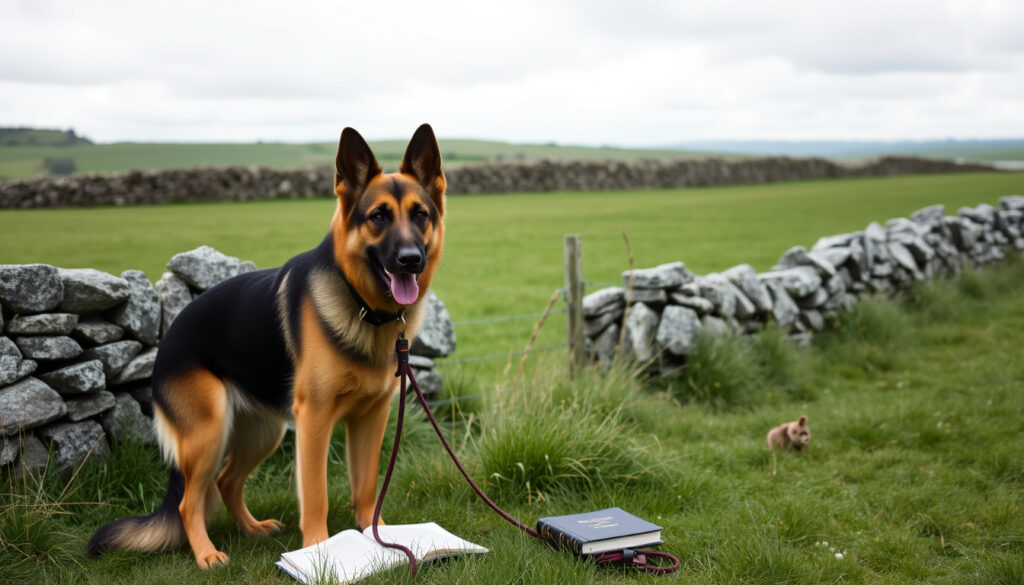
German Shepherd Ownership: Health, Temperament & Irish Law
Few dog breeds spark as much admiration—and caution—as the German Shepherd. Known for their sharp intelligence and steady loyalty, they’re a top choice for families and working roles alike.
Average lifespan: 9-13 years ·
Weight (male): 30-40 kg ·
Height (male): 60-65 cm ·
Origin: Germany
Quick snapshot
- German Shepherds are intelligent and loyal breed guides (MyFurtopia (breed guide))
- Hip dysplasia is a common health issue in the breed (MyFurtopia (breed health))
- In Ireland, German Shepherds are a restricted breed subject to additional controls (Irish Statute Book (government legislation))
- Exact apology behaviors in German Shepherds are not scientifically confirmed
- 1998: Control of Dogs Regulations placed German Shepherds on Ireland’s restricted-breed list (Irish Statute Book (dog control law))
- Some local authorities, like Dublin City Council, may restrict German Shepherds from certain housing (The Irish Times (local policy))
Six key facts, one pattern: the German Shepherd’s impressive traits come with real trade-offs.
| Label | Value |
|---|---|
| Official name | German Shepherd Dog (Irish Kennel Club (breed registry)) |
| Also known as | Alsatian (Citizens Information (legal guide)) |
| Country of origin | Germany (Government of Ireland (dog control policy)) |
| Life expectancy | 9-13 years (MyFurtopia (breed guide)) |
| Height (male) | 60-65 cm (MyFurtopia (breed guide)) |
| Weight (male) | 30-40 kg (MyFurtopia (breed guide)) |
Is a German Shepherd a Good Pet?
Temperament and loyalty
- German Shepherds are renowned for their intelligence and loyalty, making them excel in roles as service dogs and family companions (MyFurtopia (temperament description)).
- They form deep bonds with their owners but can be aloof with strangers, a trait that requires early socialisation.
The implication: this breed is not suited to owners who want a passive, low-maintenance dog. The loyalty is intense, and the intelligence means they need a job to do—or they’ll invent one.
Suitability for families
- With proper socialisation, German Shepherds can be excellent with children (MyFurtopia (family suitability)).
- Their protective nature can be an asset, but it also means they must be trained to understand when a situation is not a threat.
Families that invest in training from puppyhood get a devoted guardian. Those who skip it often end up with a nervous, reactive dog instead.
Exercise and space needs
- German Shepherds need at least 1-2 hours of vigorous exercise daily (MyFurtopia (exercise needs)).
- A small apartment without regular access to open space can be a poor fit.
What this means: if you can’t commit to daily runs, hikes, or long off-lead walks, this breed will likely develop destructive behaviours.
The pattern: a German Shepherd thrives only in an active, structured environment.
What is the Weakness of a German Shepherd?
Common health problems
Five common issues, one pattern: many are genetic and expensive to treat.
| Health issue | Risk | Source |
|---|---|---|
| Hip dysplasia | High | MyFurtopia |
| Elbow dysplasia | High | MyFurtopia |
| Degenerative myelopathy | High | MyFurtopia |
| Bloat | Moderate | MyFurtopia |
| Exocrine pancreatic insufficiency | Moderate | MyFurtopia |
| Skin and food allergies | Moderate | MyFurtopia |
Behavioral challenges
- Without consistent training, German Shepherds can develop separation anxiety and destructive chewing (MyFurtopia (behavioral challenges)).
- They are known to be vocal, barking to alert owners to anything unfamiliar.
Grooming and shedding
- German Shepherds shed heavily year-round, with two major blowouts per year (MyFurtopia (grooming)).
- Brushing several times a week is mandatory to manage fur in the home.
If you’re sensitive to pet hair or hate vacuuming, this breed will test your limits daily.
The implication: this breed requires a significant investment of time, money, and energy to manage.
What is the Lifespan of a German Shepherd?
Typical lifespan range
- The average lifespan is 9-13 years (MyFurtopia (lifespan guide)).
- Males tend to live slightly shorter lives than females.
Factors that affect longevity
- High-quality diet, regular veterinary care, and maintaining a healthy weight can add years (MyFurtopia (longevity factors)).
- Genetic screening of parents reduces the risk of inherited diseases that shorten lifespan.
Why this matters: adopting a German Shepherd is a decade-long commitment. Make sure your lifestyle can accommodate an aging dog’s needs.
Who Should Not Own a German Shepherd?
Ideal owner profile
- Experienced owners who have handled intelligent, willful breeds before (MyFurtopia (owner suitability)).
- People with time for daily training, mental stimulation, and exercise.
Living situations to avoid
- First-time owners often struggle with the breed’s dominance and high drive (MyFurtopia (first-time owner warning)).
- Sedentary households or apartments without regular access to open space are poor environments.
- Homes with very young children or elderly relatives may face challenges if the dog is not impeccably trained.
Families with the right experience and environment get an unparalleled guardian. Anyone hoping for a low-effort pet should look elsewhere.
The implication: honesty about your own lifestyle is essential before choosing this breed.
Are German Shepherds Allowed in Ireland?
Irish restricted breeds list
- German Shepherds are listed among breeds subject to additional public-place controls under the Control of Dogs Regulations 1998 (Irish Statute Book (dog control regulations)).
- They are a restricted breed, not banned—ownership is allowed but with strict conditions (Citizens Information (restricted breeds guide)).
Legal requirements and exceptions
- In public, a German Shepherd must be kept on a strong short lead not exceeding 2 metres, by a person over 16 years of age who can control the dog (Government of Ireland (dog control policy)).
- The dog must be securely muzzled in all public places (Government of Ireland (muzzling requirement)).
- Failure to comply can result in the dog being seized or a court order for destruction (Irish Statute Book (dangerous dog provisions)).
The pattern: Ireland’s approach is regulation, not prohibition. But the rules are strict and carry real consequences.
Comparison: German Shepherd vs. Common Owner Profiles
Three owner scenarios, one pattern: the match quality depends entirely on training commitment and living space.
| Owner type | Suitability | Key challenge |
|---|---|---|
| First-time owner | Low | Breed’s dominance and high exercise needs overwhelm novices (MyFurtopia) |
| Active family with yard | High | Requires daily training and socialisation (MyFurtopia) |
| Apartment dweller | Low | Barks, sheds, and needs space to roam (MyFurtopia) |
Upsides
- Exceptional intelligence and trainability
- Loyal and protective of family
- Versatile in roles: service, police, therapy
- Adapts well to cold climates
Downsides
- High risk of hip/elbow dysplasia and bloat
- Heavy shedding requires constant grooming
- Not suitable for first-time owners or small homes
- Restricted breed in Ireland with legal obligations
Confirmed Facts vs. What’s Unclear
- Confirmed facts: German Shepherds are intelligent, loyal, and confident (MyFurtopia). They are restricted in Ireland (Irish Statute Book). Hip dysplasia, elbow dysplasia, degenerative myelopathy, and bloat are common health concerns (MyFurtopia).
- What’s unclear: The exact apology behaviors of German Shepherds have not been scientifically studied.
Expert Perspectives
German Shepherds are a restricted breed in Ireland. Owners must comply with muzzling and lead requirements in public.
— Dogs Trust Ireland (animal welfare charity)
The breed originated in Germany in the late 19th century, developed for herding and protection work.
— Wikipedia (breed history)
For Irish residents considering a German Shepherd, the decision is clear: you can own one, but only if you’re ready for daily exercise, ongoing training, and strict legal compliance. Without that commitment, both you and the dog will struggle. For anyone else, the same rule applies—this breed demands a confident, active owner who sees their dog as a partner, not a pet.
Related reading: Healthiest Water Bottles: Stainless Steel vs Plastic Guide
help.dogs.ie, mayo.ie, gov.ie, australiavoice.org, irishstatutebook.ie, sdcc.ie
For a detailed look at how these traits apply specifically to Irish owners, see this German Shepherd in Ireland guide.
Frequently asked questions
How much exercise does a German Shepherd need?
At least 1-2 hours of vigorous exercise daily, including off-lead running and mental stimulation (MyFurtopia).
What is the best diet for a German Shepherd?
A high-quality, large-breed formula with balanced protein and fat, plus joint-supporting supplements like glucosamine (MyFurtopia).
Are German Shepherds good with children?
Yes, when properly trained and socialised early. Their protective nature can be an asset, but they must learn appropriate behavior around kids (MyFurtopia).
How much does a German Shepherd shed?
Heavily year-round, with two major shedding seasons. Daily brushing is recommended to manage fur (MyFurtopia).
How to train a German Shepherd puppy?
Use positive reinforcement, start early with basic commands, and prioritise socialisation with people and other dogs (MyFurtopia).
How much does a German Shepherd puppy cost?
From a reputable breeder, expect €1,000–€3,000, depending on lineage and location. Adoption from a rescue is cheaper but less common (Irish Kennel Club).
What mistakes do German Shepherd owners make?
Under-exercising, skipping training, leaving them alone for long hours, and not addressing health issues early (MyFurtopia).
More related posts
 Catherine Tate: Relationship History, Net Worth, and Current Projects
 Colin Fassnidge: Biography, Cocaine Driving, and Personal Life
 Qantas Flight Insurance: Coverage, Cost, and Is It Worth It
 Sarah Snook Movies and TV Shows: Full Filmography Guide
 24 Hour Chemist Near Me Open Now: Late Night Dublin Options
 Best Muscle Cars for Men 2024 – Top Rankings and Buyer’s Guide
 DJI Air 3S Review: Specs, Lidar, Camera & Flight Range
