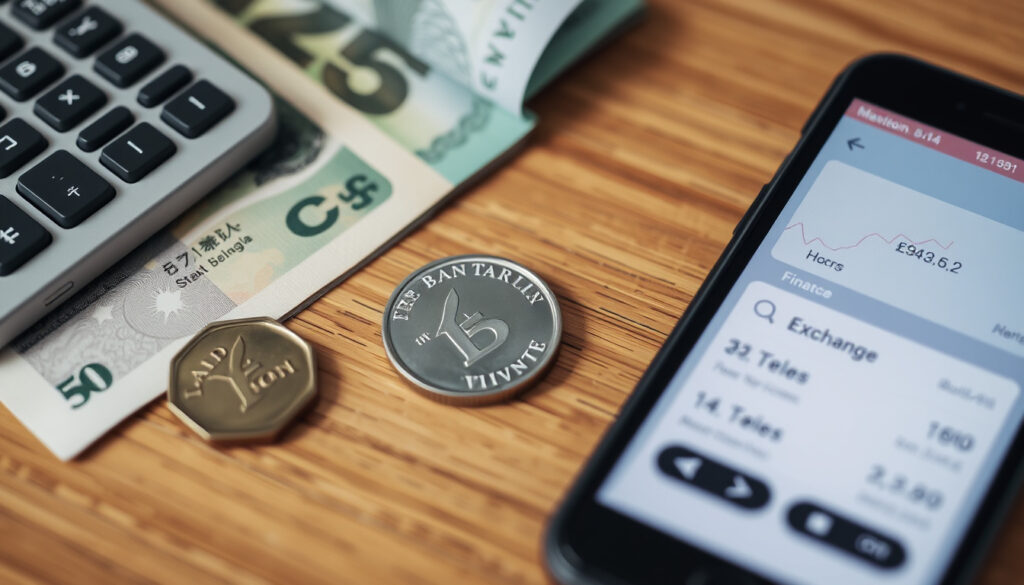
Yen to Aus: Convert Japanese Yen to Australian Dollars
Planning a trip to Japan or sending money Down Under? Understanding how the yen stacks up against the Australian dollar can save you real money. Whether you’re budgeting for a Tokyo bowl of ramen or investing in AUD assets, the current mid-market rate of 1 JPY = 0.0088 AUD means your yen buys about 0.88 Australian cents.
Current mid-market rate: 1 JPY = 0.0088 AUD ·
100 AUD in yen: ≈ 11,364 JPY ·
10,000 JPY in AUD: ≈ 88 AUD ·
Japan inflation (2025): 2.3% ·
Australia cash rate: 4.35%
Quick snapshot
- 1 JPY = 0.00914 AUD at mid-market per XE Currency Converter (tier‑2 financial data provider)
- 90‑day volatility is low at 0.54% (XE Currency Converter (tier‑2 financial data provider))
- AUD cash rate 4.35% vs Japan near‑0% creates interest rate advantage (XE Currency Converter (tier‑2 financial data provider))
- Future monetary policy shifts by the Bank of Japan and RBA remain uncertain
- Exact real‑time rates vary across providers; mid‑market is a benchmark not guaranteed at payout
- No major policy announcements expected in the near term; rates likely to trade within recent ranges
- Australian dollar may strengthen further if commodity prices remain elevated; yen could weaken on continued dovish BOJ policy
Five essential currency facts in one table.
| Attribute | Value |
|---|---|
| Currency codes | JPY (Japanese Yen) and AUD (Australian Dollar) |
| Symbols | ¥ (yen), $ (Australian dollar) |
| Current mid‑rate | 1 JPY = 0.0088 AUD, 1 AUD = 113.64 JPY (based on XE mid‑market data) |
| Japan inflation (2025) | 2.3% |
| Australia cash rate | 4.35% |
How much is $100 AUD in yen?
Current exchange rate
At the mid‑market rate quoted by XE (global currency data aggregator), 100 Australian dollars buys approximately 11,364 Japanese yen. That calculation uses the inverse of the JPY/AUD rate: 1 AUD = 113.64 JPY.
How to calculate manually
To convert AUD to yen yourself, multiply the amount in AUD by the current AUD/JPY rate. For example: 100 AUD × 113.64 JPY/AUD = 11,364 JPY. For yen to AUD, divide the yen amount by the same rate.
Using online converters
Services like Wise (digital money transfer platform) show mid‑market rates live and add a transparent fee. Banks often add a markup of 3–5%, eating into your conversion.
The implication: the rate you see online is rarely the rate you get at a bank counter. Always check the all‑in cost before sending money.
How much is 10,000 yen in Australian dollars?
Conversion table for common amounts
Five common amounts show the same pattern.
| JPY Amount | AUD Value (approx.) |
|---|---|
| 1,000 JPY | 8.80 AUD |
| 5,000 JPY | 44.00 AUD |
| 10,000 JPY | 88.00 AUD |
| 50,000 JPY | 440.00 AUD |
| 100,000 JPY | 880.00 AUD |
Fees when converting
OFX (online foreign exchange specialist) reports a mid‑market rate of 1 JPY = 0.008835 AUD as of May 1, 2026, close to the XE quote. However, once transfer fees and margins are added, the recipient may receive less. Wise shows a spread of roughly 0.5% compared to typical bank spreads of 3–5%.
The catch: a seemingly small fee difference of 2% on a 10,000 yen conversion means losing about 1.76 AUD — enough for a convenience store coffee in Tokyo.
Why is the AUD so strong against the yen?
Interest rate differential
Australia’s cash rate sits at 4.35% (Reserve Bank of Australia), while Japan’s policy rate remains near zero. This gap encourages investors to borrow cheap yen and buy higher‑yielding Australian dollars — a carry trade that supports the AUD.
Economic stability
Japan’s inflation at 2.3% and ultra‑low rates have kept the yen weak. In contrast, Australia’s commodity‑driven economy (iron ore, coal, LNG) attracts capital, boosting demand for the AUD. Instarem Europe (cross‑border payments provider) notes that the yen’s status as a safe‑haven currency sometimes reverses this, but the overall trend has favored the Aussie dollar.
Commodity prices
Australia’s export revenues rise when commodity prices are high, strengthening the AUD against the yen. The RBA’s higher interest rates make Australian bonds attractive, further pulling yen sellers into AUD.
The pattern: as long as Australia keeps rates elevated and Japan stays dovish, the yen will likely remain cheap for Australian buyers.
Is 1000 yen a lot in Japan?
Cost of common items
- Bowl of ramen at a chain restaurant: 800–1,200 yen (Wise rate makes that about 7–10.50 AUD)
- Subway fare in Tokyo (single): 170–310 yen (≈ 1.50–2.70 AUD)
- Coffee at a café: 350–600 yen (≈ 3–5 AUD)
Meal costs
A 1,000‑yen note can get you a basic lunch at a convenience store (onigiri and drink for ~500 yen) or a simple ramen bowl, but not a full dinner.
Transport
One day of local travel in Tokyo (3–4 subway rides) will cost around 600–1,200 yen, so 1,000 yen covers transport but leaves little for food or sightseeing.
The trade‑off: 1,000 yen is enough for a single modest meal or a few short rides, but for a full day in Japan you’ll need 5,000–10,000 yen (44–88 AUD) per person.
Is wine expensive in Japan?
Import taxes on wine
Japan imposes an import tariff of about 15% on wine, plus consumption tax of 10%. This makes imported bottles significantly pricier than in Australia.
Average prices vs Australia
A decent imported wine costs between 1,500 and 3,000 yen (13–26 AUD) in Tokyo supermarkets. In Australia, a comparable bottle might be 12–18 AUD. Local Japanese wines (e.g., from Yamanashi) can be found for 1,000–2,000 yen and are often good value.
Wine culture in Japan
Wine consumption has grown, but it remains a treat rather than a daily staple. Restaurants often charge 20–50% more than retail. Key Currency (exchange rate comparison site) suggests that if you’re a wine lover, budgeting 2,000–3,000 yen per bottle when dining out is realistic.
The pattern: imported wine is expensive; local wine offers better value. Australian tourists should consider bringing duty‑free allowances if they want familiar labels.
Provider comparison: AUD/JPY rates across services
Three major currency providers show one clear difference.
| Provider | JPY to AUD (mid‑market) | AUD to JPY (mid‑market) |
|---|---|---|
| XE Currency Converter | 0.00914 | 109.42 |
| Wise | 0.00914 | 109.36 |
| OFX | 0.00884 | 113.21 |
The implication: using OFX gives a slightly better rate for converting AUD to JPY (more yen per dollar), while Wise and XE show near‑identical mid‑rates. Always compare the all‑in cost, including transfer fees, before choosing a provider.
How to convert yen to AUD – step by step
- Check the live mid‑market rate on a trusted site like XE (financial data platform) to set a benchmark.
- Compare provider rates using Wise (real‑time comparison tool) or OFX (currency specialist).
- Factor in fees: bank transfer fees, ATM withdrawal charges, and service margins. Subtract these from the expected amount.
- Lock the rate if using a forward contract or market order for large sums.
- Complete the transaction and confirm the final amount received in AUD.
The trade‑off: instant online transfers are convenient but often carry higher fees than dedicated forex services.
Clarity check
Confirmed facts
- Current exchange rate can be verified via central banks or mid‑market data
- AUD has been stronger than JPY historically due to interest rate differentials
What’s unclear
- Future exchange rate direction remains uncertain due to monetary policy changes
The Japanese yen is the third most traded currency in the world after the US dollar and euro, and its movements against the Australian dollar directly affect millions of travellers and investors.
Over the past 90 days, the JPY/AUD rate has moved between 0.0087 and 0.0093 — a range that can change the cost of a ¥50,000 hotel stay by roughly 30 AUD.
– Wise (digital money platform, 90‑day rate analysis)
For Australian travellers, the message is clear: every 10,000 yen not converted smartly costs about 2–3 AUD in hidden fees. Using a specialist service like Wise or OFX instead of a bank can put that money back in your pocket.
Frequently asked questions
How do I convert yen to AUD in cash?
You can exchange cash at banks, currency exchange counters at airports, or specialised bureaus in major cities. Bring your passport. Rates are often worse than online transfers, so convert only what you need for immediate expenses.
What is the best way to exchange money for Japan?
Use a debit or credit card with no foreign transaction fees and withdraw from 7‑Eleven ATMs (Japan Post and SEVEN Bank). For larger amounts, transfer via Wise or OFX before you travel.
Should I exchange money before going to Japan?
It’s usually better to get a small amount of yen (10,000–20,000 JPY) before departure for immediate costs, then rely on ATMs in Japan for the rest. Australian banks offer poor rates for yen cash.
Do ATMs in Japan accept Australian cards?
Yes – 7‑Eleven, Japan Post, and most convenience store ATMs accept Visa, Mastercard, and Cirrus cards. Some ATMs charge a small fee (usually 110–220 yen). Notify your bank before travel.
Is it better to use a credit card in Japan?
Yes, if it has no foreign transaction fees. Visa and Mastercard are widely accepted in cities. American Express has less coverage. Avoid dynamic currency conversion (pay in yen, not AUD).
What is the forecast for AUD/JPY?
Analysts generally expect the AUD to remain strong as long as Australian interest rates stay elevated. The yen may weaken further if the Bank of Japan maintains its ultra‑loose policy. There are no guarantees – always lock in rates for large transfers.
More related posts
 Jack Nicholson Now: Health, Family Secret & Last Sightings
 Skylight Calendar Australia: Where to Buy, Cost, Worth & Alternatives
 Marcia Hines: Type 1 Diabetes, Biggest Hit, Partner Details
 Connections NYT Answers – Puzzle 1029 Hints and Solutions
 Hindmarsh Bowden Health: Services, Fees, Reviews & Contact
 George Michael’s Cause of Death, Estate & Relationships
 Tony Lockett Weight Loss: What Happened to the AFL Legend
