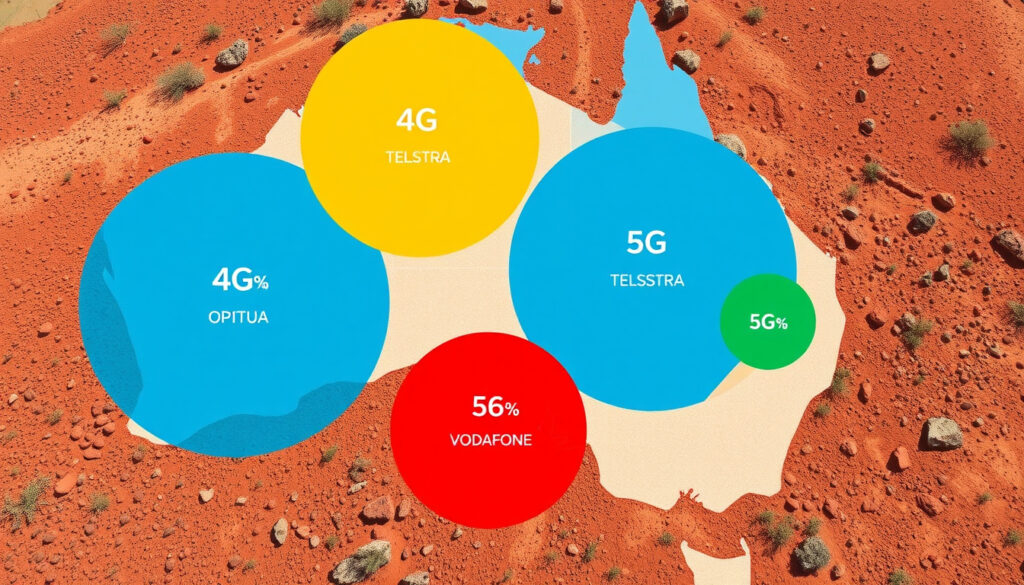
Optus Coverage Map: 4G/5G vs Telstra & Vodafone
Pulling up a coverage map before signing up for a phone plan feels like a no-brainer — until you notice that each carrier’s map tells a slightly different story. Optus claims 98.5% population coverage, but how does that stack up against Telstra’s reach or Vodafone’s footprint after its 2025 network-sharing deal? This guide cuts through the marketing language and puts the numbers side by side so you can see exactly what “good coverage” actually means in your area.
Optus population coverage: 98.5% · Optus network types: 4G/5G · Major competitors: Telstra, Vodafone · MVNO users on Optus: multiple carriers · Tower sharing: with Vodafone rural
Quick snapshot
- Optus covers 98.5% of Australian population with 4G (Reviews.org)
- Vodafone shares rural towers with Optus since January 2025 (Finder)
- MVNOs on Optus get full 5G access — a key differentiator (Reviews.org)
- Vodafone does not publish a specific 5G population coverage percentage (Reviews.org)
- Exact signal strength differences vary by location without user-side testing tools (Reviews.org)
- Indoor coverage performance not broken out in carrier maps (Reviews.org)
- January 2025: Vodafone-Optus network-sharing partnership announced (Reviews.org)
- Mid-2026: ACMA requires standardized coverage maps from all carriers (Canstar)
- 2025: Opensignal 2025 Australia Mobile Network Experience report released (Reviews.org)
| Network Owner | Coverage Type | Population Reach | Key Map Source | Competitor Shares |
|---|---|---|---|---|
| Optus | 4G/5G | 98.5% | optus.com.au/coverage | Vodafone rural towers |
| Telstra | 4G/5G | 99.7% | telstra.com.au/coverage | None |
| Vodafone | 4G/5G | 98.4% | vodafone.com.au/coverage-checker | Optus rural towers |
| Telstra Wholesale | 4G/5G | 98.8% | wholesaler portals | MVNO access |
What is Optus coverage?
Optus operates its own independent network infrastructure across Australia — it does not rent or share with Telstra. As of 2026, Optus 4G reaches 98.5% of the Australian population, with 5G coverage extending to approximately 80.5% of the population.
Optus 4G/5G network map
The Optus coverage map, available at optus.com.au (Official Optus coverage tool), lets users enter their address or postcode to see estimated indoor and outdoor signal strength. The map displays 4G and 5G availability separately, so you can check whether your area falls within the 5G rollout zone.
According to Opensignal’s 2025 report, Optus recorded the fastest average 5G download speed at 212.3 Mbps — outpacing both Telstra and Vodafone. However, this speed advantage applies primarily in metro areas where 5G density is highest.
Population and area coverage
Population coverage metrics differ from geographic area coverage. Optus covers 98.5% of the Australian population, but this concentrated percentage covers a relatively smaller land area compared to Telstra’s network, which services 99.7% across roughly 3 million square kilometres.
This distinction matters most for rural users: a carrier with 98.5% population coverage may still leave gaps in regional areas where fewer people live. Optus has expanded its rural presence through tower-sharing deals, but Telstra still leads in remote coverage.
Population coverage percentages sound similar on paper, but for users outside major cities, the difference between 98.5% and 99.7% can mean the difference between a usable signal and dropped calls.
Who has more coverage, Vodafone or Optus?
Vodafone’s 4G coverage sits at 98.4% of the Australian population — nearly identical to Optus. The gap between the two networks is just 0.1 percentage points on population metrics, making direct comparison largely a wash for most urban users.
Tower sharing details
The more significant story is infrastructure sharing. In January 2025, Vodafone and Optus announced a network-sharing partnership that doubled Vodafone’s geographic footprint from 400,000 to over 1,000,000 square kilometres. Under this arrangement, Vodafone accesses Optus towers in rural and regional areas where its own infrastructure is sparse.
Optus benefits from this arrangement less directly — its own network already covers a broad area. The real win for Optus users comes indirectly: the partnership signals confidence in Optus infrastructure quality, as Vodafone chose to rely on it for areas where Optus had existing coverage.
Coverage overlap map
Interactive coverage comparison tools like nPerf (Community-sourced signal maps) allow users to overlay coverage maps for all three major carriers. These maps show where networks overlap and where gaps exist, though nPerf data is crowd-sourced and may not reflect real-time network conditions.
In capital cities, all three networks perform strongly. The coverage overlap maps reveal that gaps between Optus and Vodafone narrow considerably in metro areas — both carriers have dense metro 5G deployments. The divergence appears in rural zones, where Vodafone’s reliance on Optus sharing becomes visible.
Vodafone does not publish its own 5G population coverage figure. This makes direct 5G comparison between Optus and Vodafone difficult without relying on third-party speed tests or crowd-sourced data.
Which network has the best coverage in Australia?
Telstra holds the top position for both 4G and 5G coverage, servicing 99.7% of Australians across approximately 3 million square kilometres. The gap between Telstra and Optus is modest in cities but widens considerably in regional and remote areas.
Optus vs Telstra vs Vodafone
A head-to-head comparison reveals a clear tier structure:
| Metric | Telstra | Optus | Vodafone |
|---|---|---|---|
| 4G Population Coverage | 99.7% | 98.5% | 98.4% |
| 5G Population Coverage | 95% | 80.5% | Not published |
| 5G Sites (ACCC 2025) | 5,082 | 4,038 | 3,400+ |
| Rural Signal Strength | Best | Gaining ground | Improving via sharing |
| Metro 5G Speed (Opensignal) | Strong | Fastest (212.3 Mbps avg) | Lower |
According to Opensignal’s geographic coverage ratings, Telstra scores highest in populated areas on a 0-10 scale. Optus comes second, and Vodafone trails slightly — though Vodafone’s position has improved since the January 2025 partnership with Optus.
Regional maps: TAS, QLD, NSW
Regional breakdowns tell a more nuanced story than national percentages suggest. Telstra’s advantage in Tasmania, Queensland, and New South Wales is most pronounced outside metropolitan areas. Optus performs well near coastal population centres but thins out in inland rural zones.
For users in Tasmania specifically, Optus coverage holds up well in the Hobart and Launceston corridors but becomes less reliable in the state’s western and northern highlands regions. Queensland users see similar patterns: strong in Brisbane, Gold Coast, and Cairns corridors, with coverage weakening in outback areas. New South Wales mirrors this urban-rural divide.
Vodafone’s coverage in these states now benefits from its Optus tower-sharing arrangement, though the exact coverage quality depends on which operator’s infrastructure serves a given location.
Do Optus and Vodafone use the same towers?
Optus and Vodafone operate separate networks in most urban areas. However, a rural network-sharing agreement means they share infrastructure in regional and remote locations where building duplicate towers would be commercially unviable.
Rural network sharing
The Vodafone-Optus partnership announced in January 2025 allows Vodafone to use Optus towers for voice and data services outside metro areas. This doubled Vodafone’s rural footprint effectively overnight.
Optus, for its part, does not use Vodafone towers — it relies entirely on its own infrastructure. The sharing arrangement is one-directional: Vodafone benefits from Optus coverage in areas where Optus already had infrastructure, but Optus does not rely on Vodafone towers.
Impact on coverage
For Optus customers, the impact of this arrangement is positive: it signals network investment and infrastructure trust. For Vodafone customers, the arrangement significantly improved coverage in previously underserved areas.
Network sharing does not mean identical coverage. Users should still check the Optus coverage map before assuming their area has full Optus-tier service via Vodafone — the arrangement specifically targets rural and regional expansion, not metro densification.
If you live in a regional area and your Vodafone plan suddenly started working better after January 2025, the Optus tower-sharing deal is likely why. This also means Vodafone’s rural coverage now closely mirrors Optus in those areas.
Which carriers use Optus Network?
Several Mobile Virtual Network Operators (MVNOs) run their services over Optus infrastructure. Unlike some Telstra MVNOs that receive capped 5G access, MVNOs on the Optus network typically receive full 5G access — a notable advantage.
Optus MVNOs list
Carriers using Optus infrastructure include Southern Phone, which explicitly markets Optus 4G/5G coverage reaching 98.5% of the Australian population. Other MVNOs piggyback on Optus towers, offering prepaid and postpaid plans at lower price points than Optus flagship plans.
The Optus MVNO ecosystem benefits from the parent network’s infrastructure investment. MVNO customers access the same towers and 5G spectrum as Optus direct customers, though some carriers may implement speed tiers or fair-use policies.
Best plans on Optus network
When evaluating MVNO plans on the Optus network, key factors include 5G access, data allowances, and international roaming inclusions. The Optus-owned network advantage means most MVNO customers get full 5G speeds without the premium Telstra pricing.
However, MVNO customers should note: while they access Optus infrastructure, they may experience different customer service experiences, billing systems, and plan structures. Coverage itself should be identical to Optus direct customers using the same network bands.
Upsides
- Optus MVNOs get full 5G access — unlike some Telstra MVNOs
- Multiple carriers compete on Optus infrastructure, driving plan value
- 98.5% population coverage available to MVNO customers
- Southern Phone and other MVNOs offer competitive pricing
Downsides
- Rural coverage still trails Telstra for all Optus-network carriers
- Metro-focused 5G rollout leaves some suburban areas on 4G only
- Vodafone’s tower-sharing may confuse users about actual network ownership
- Indoor signal performance not guaranteed by coverage percentages
How to check your Optus coverage
Following these steps helps you verify actual coverage at your address before committing to an Optus or Optus-MVNO plan.
- Visit the official coverage map — Go to optus.com.au (Official Optus coverage tool) and enter your address or suburb postcode.
- Check both 4G and 5G layers — The map lets you toggle between network types. A 4G-strong address may not have 5G, which matters if you want the fastest speeds.
- Review indoor vs outdoor estimates — Optus provides separate indoor signal strength estimates. Thick walls or basement locations may reduce actual performance below map predictions.
- Compare with nPerf community maps — For crowd-sourced real-world data, cross-reference nPerf (Community-sourced signal maps) to see user-reported speeds and coverage in your specific location.
- Check Vodafone coverage too — If you’re considering a Vodafone plan, use Vodafone (Official Vodafone coverage tool) to compare. The networks overlap substantially in metro areas.
“Telstra still has the best signal in rural but Optus is gaining ground and Vodafone remains an affordable option for metro mobile coverage.”
— Fergus Halliday, Journalist and Editor, Reviews.org
“Telstra has the largest network in Australia, servicing 99.7% of Australians across roughly 3 million square kilometres.”
— Finder
Related reading: What Is Telecommunications · Pixel 8 Pro Review
Optus’ extensive 4G/5G coverage powers MVNOs too, with Coles Mobile plans delivering budget prepaid options and data rollover across Australia.
Frequently asked questions
How do I check Optus coverage map?
Visit optus.com.au/about/network/coverage and enter your address or postcode. The interactive map shows 4G and 5G availability separately, with estimated indoor and outdoor signal strength for each network type.
Is Optus 5G coverage nationwide?
Optus 5G covers approximately 80.5% of the Australian population as of 2026. This is concentrated in metropolitan and major regional areas. Rural and remote locations may have 4G only, with 5G rollout continuing across the network.
Optus coverage map Australia full view?
The full Australia coverage view is available on Optus’s official website and through third-party tools like nPerf. The official map lets you zoom to any location and toggle between 4G and 5G layers to see the complete network footprint.
Best network for rural Australia?
Telstra remains the best choice for rural Australia with 99.7% population coverage and the strongest rural signal. Optus is gaining ground but still trails Telstra outside major population corridors. Vodafone’s coverage improved via Optus sharing but still lags in the most remote areas.
Does Optus cover Tasmania well?
Optus covers Tasmania well along the Hobart and Launceston corridors and major coastal population centres. Coverage weakens in the state’s western and northern highlands regions. For comprehensive Tasmania coverage, checking the Optus map for your specific address is recommended.
Optus vs Vodafone signal strength?
In metropolitan areas, Optus and Vodafone have comparable signal strength. Optus leads in 5G speed (212.3 Mbps average per Opensignal) while Vodafone offers more affordable pricing. In rural areas, Vodafone now benefits from Optus tower-sharing, making coverage quality similar between the two.
MVNOs on Optus network list?
Several MVNOs operate on the Optus network, including Southern Phone. These carriers offer plans at lower price points while providing full 5G access — a key advantage over some Telstra MVNOs that face 5G restrictions.
More related posts
 Black Cargo Pants – Top 2025 Picks and Styling Guide
 Paul Newman: Biography, Death, and Lasting Legacy
 Capricorn Horoscope Today – Love, Career, Health Predictions
 Tyrese Proctor: NBA Career, Contract, and Stats | 2025-26
 Energy Australia App – Features, Setup and Usage Guide
 Ahmed al-Sharaa – Syria’s Interim President
 Catherine Tate: Relationship History, Net Worth, and Current Projects
 Barry Keoghan: Biography, Relationships, Movies, and FAQs
